
 Nuclear in California: Southern California Edison (SCE) announced this week that its” staffing and costs are significantly higher than other similar dual unit, non-fleet nuclear power plants.”. As a result, SCE announced its intent to downsize the workforce to 1,500 – a reduction of approximately 730 employees – beginning fourth quarter of 2012.
“ The steam generator issues… require that SCE be prudent with its future spending while SCE and regulators review the long-term viability of the nuclear plant. The reality is that the Unit 3 reactor will not be operating for some time.” said the company.
Kern Getting Oil By Rail From North Dakota
California’s oil patch is getting shipments of oil from North Dakota in 100 car unit trains since last year. That may be good news for California consumers who face higher gasoline prices this month due to a fire at a Bay Area Chevron refinery. The Bakersfield Californian says Kern Oil and Refining is getting oil shipped in by rail from the booming Bakken fields in the upper Midwest despite all the ‘Black Gold’ in Kern county.
Bakken sweet crude is selling for about $10 more per barrel than Kern heavy crude and $16 more than Alaskan crude.
A second refinery in Bako that recently reopened – owned by Alon may bring crude from the Midwest as well.The competition is pressuring Kern oil prices and could mean lower prices at the pump for West Coast motorists in the future.
North Dakota recently passed California in oil production. North Dakota’s oil production averaged 660 thousand barrels per day in June 2012 -71% over June 2011 volumes. Production gains in the Bakken formation are the result of accelerated development activity, primarily horizontal drilling combined with hydraulic fracturing. There are now in excess of 4000 oil wells -up 68% from June 2011.
Oil Rides The Rails
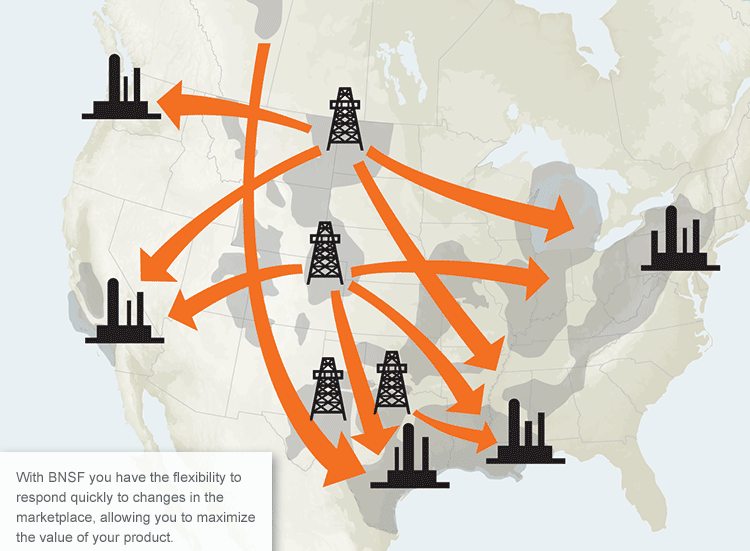
With all that oil and limited pipelines to carry it – the rail companies have stepped in.The U.S. Energy Information Administration says that rail deliveries of oil and petroleum products in the United States rose by 38 percent in the first half of 2012 compared to the same period last year with a rail tanker car carrying about 700 barrels.
California is not alone in receiving Midwest oil rail.Two large refiners in the state of Washington are gearing up.Tersoro who has also has refineries in Utah and LA and recently bought BP’s holdings in California – has announced it will replace Alaska crude oil with Midwest oil at its 120,000 bpd refinery in Anacortes, Washington.
Tesoro plans to begin shipments of up to 40,000 barrels per day of Bakken crude to the refinery in September 2012. BP’s Cherry point refinery may also bring in unit trains.Earlier this year that refinery also had a fire helping to spike West coast gas prices.
Unit trains can transport about 60,000 barrels of oil. Union Pacific and BNSF in the West are increasing their loads of oil even as their coal shipments decline.
A recent report suggests the ‘ shale to rail’ trend is nationwide.”Several companies have announced new investments to boost shipments of crude by rail. In April, terminal operator U.S. Development Group LLC said it finished its expansion of its St. James Rail Terminal, which receives shipments of crude from the Bakken and other regions, to handle 130,000 barrels a day of crude shipments. Union Pacific Corp. (UNP) CEO Jack Koraleski told investors last month he expects the company’s shale oil business to grow to almost 400,000 carloads this year. Recently, pipeline operator Plains All American Pipeline LP (PAA) said it is spending $125 million to build new rail facilities in Colorado and Virginia.”
Competition Works
“Competition is working to reduce crude oil costs in the state” says Walt Dwelle of Nella Oil Co. Dwelle cites the Tesoro pipeline from their Utah refinery to Las Vegas that is bringing in cheaper Midwest refined product to Nevada, a state that used to be supplied by California refiners. “That leaves more gallons of gasoline for California.”
Dwelle says the rise of Tesoro in recent years as major player in California is a turn around from a few years back when it was in financial straights.
Dwelle says gasoline futures that jumped 40 cents after the Aug 6 Chevron fire have now recovered about 25 cents of that and California gas prices should be stable to lower now with the end of summer driving season.He says Chevron has ordered stock to make gasoline at its Richmond plant even though the refinery could be shut 6 months.Oil is being shipped in by tanker.In addition the company has a plant in El Segundo that could crank.
If fracturing has helped North Dakota – California’s’ drillers hope the same thing happens in California once regulations are in place here.That would mean more cleaner burning sweet crude.
EPA Defends Decision to Reduce, Not Eliminate, 2012 Cellulosic Requirement
In a Monday, Aug 20 court filing, EPA defended its decision to massively reduce, but not eliminate, the 2012 cellulosic biofuel requirement of the renewable fuels standard (RFS2).
For 2012, EPA reduced the cellulosic biofuel requirement from 500 million gal to 8.65 million gal.
”When projecting expected cellulosic biofuel production in the context of setting the 2012 applicable volume of cellulosic biofuel, EPA reasonably considered the production capacity likely to be developed throughout the year, while API [the American Petroleum Institute] would have EPA rely narrowly and solely on proven past cellulosic biofuel production,” EPA explained in its Aug. 20 filing with the U.S. Court of Appeals for the District of Columbia Circuit.
In March, API filed its challenge against what it viewed as EPA’s “unachievable” requirements for use of cellulosic biofuels in the 2012 RFS. API and other petroleum groups view the cellulosic biofuel mandate as a tax on manufacturers of gasoline. It wants EPA to set the cellulosic biofuel requirement at a realistic volume.
Specifically, API challenged EPA on whether the agency’s determination of the cellulosic biofuel that would be sold or introduced into commerce this year was “based on” an estimate provided by EIA and was reasonable, and whether EPA reasonably determined not to decrease the volume of advanced biofuel sold or introduced into commerce this year because other advanced biofuel sources would likely make up the expected shortfall in cellulosic biofuel production.
As EPA explained, its “projected volume of cellulosic biofuel is also reasonable and supported by the administrative record. EPA examined the most current sources of information regarding anticipated cellulosic biofuel production of each company with production potential, explained its reasoning, including why its estimates deviated from the EIA’s and reasonably concluded that 8.65 million gallons of cellulosic biofuel (or 10.45 million ethanol- equivalent gallons) would likely be available in 2012,” it noted.