
Madera Pacific Ethanol Will See New Sugar Plant Next Door
August12,2014
It’s better times for California’s ethanol producers and investment dollars are flowing with technology to make their production plants more efficient as well as multiple feed source plans to make low-carbon, cellulosic biofuel. “We are just about there” says Paul Koehler, spokesman for Sacramento-based Pacific Ethanol, referring to the long-time effort (and long criticized) to begin making ethanol from farm waste and nonfood feedstock.
 One of the benefits of cellulosic ethanol is that it reduces greenhouse gas emissions by 85% over reformulated gasoline. Some feel cellulosic ethanol’s potential is vast noting that the Department of Energy has identified 1.3 billion tons of harvestable cellulosic biomass in the US that could be used to meet more than one-third of domestic transportation fuel demand.
While critics decry mandates for the cleaner burning cellulosic fuel arguing that despite promises – to date there has been virtually none made – Koehler points to an investment of a billion dollars in 3 new Midwest ethanol plants that will make the fuel out of leaves, stalks and corn cobs being funded by major players like Dupont,Poet and Abengoa with production starting this fall, each with at least 25 million gallon capacity.
Now that is happening in California too on a smaller scale with a collaboration that may hit the sweet spot.
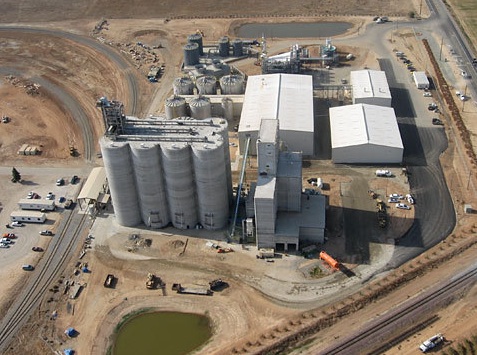
Last December Sweetwater Energy and Pacific Ethanol agreed that the the biofuel maker would buy industrial cellulosic sugars from Sweetwater to be produced at a new facility next to one of their ethanol plants. It was originally envisioned to be located at the PE Stockton plant. But in the past week Pacific Ethanol announced the Madera location using ample land the company owns around the their 40 MM gallon facility to build a new plant that will supply the waste based sugar for up to 3.6 million gallons of cellulosic ethanol annually.
“We are in the permitting stage for Sweetwater who will design and build their plant over the next 24 months and be in operation by the end of 2016” estimates Paul Koehler. Industrial sugars are said to 6X as efficient as corn in making ethanol. Koehler says to expect the new plant will employ 20 to 30.
“The Sweetwater platform furthers our initiative in producing next-generation fuels such as cellulosic ethanol while providing additional flexibility in sourcing, reducing feedstock costs and enhancing plant operating margins.” says CEO Neil Koehler.
In a second cellulosic initiative Pacific Ethanol is working with Visalia based Edeniq to use their patented enzyme that would convert corn stover to ethanol,a waste product now that is not used. Koehler adds that which PE plant will use the technology is not yet set.
Edeniq announced just weeks ago that the EPA ruled that corn kernel fiber qualifies as a cellulosic feedstock under the renewable fuel standard (“RFS”) program regulations. This rigorous determination will allow Edeniq’s PATHWAYTM Platform to be used by customers to produce cellulosic ethanol inside corn ethanol plants.
Edeniq’s patented PATHWAYTM Platform combines the CellunatorTM technology with an enzyme cocktail to break down corn kernel fiber, releasing cellulosic sugars into the fermentation process. Corn kernels contain approximately 13% cellulosic fiber that remains unconverted in a typical ethanol plant.
This is how cellulosic ethanol will be made here with so called “Bolt On” technology like Edeniq’s that enables existing corn ethnaol plants to also make ultra low carbon biofuel that fetches a higher price.
“Cellulosic ethanol produced from corn kernel fiber is one of the fastest and most cost-effective ways to improve the efficiency and sustainability of the ethanol industry in the United States,” said Brian Thome, President and CEO of Edeniq.
Edeniq is also working with a Chinese company to do cellulosic over there as well.In July Edeniq and Global Bio-chem said they intend to integrate their technologies in a commercial demonstration plant to produce 50,000 metric tons per year of industrial sugars from corn stover, and subsequently to form a joint venture to further develop and commercialize their technology platform. Global Bio-chem is currently working on modification of corn stover, consisting of leaves, stalks and cobs of corn at its facility in the Jilin Province of China.
More Investment In Madera
Still more; in Madera, Paul Koehler says their are also installing corn oil manufacturing by the end of this year. The process converts a by product into a valuable feed. Koehler also says Madera will install technology to make another feed product – Kornplex – on a small scale and ramping up later. Lastly, Koehler says they are studying possible cogeneration at their plants to make electricity.”We are a steam hog” jokes Koehler, and are exploring various strategies to make power in a state with sky high electricity costs.
All this investment is happening in Madera, a plant that had been idled for five years and was only restarted earlier this year after a major retooling.
Speaking of feed sources PE as well as two other California corn ethanol plants are sharing a energy commission grant
build up a local market to grow grain sorghum as an alternative to corn. Grain sorghum can be grown using less water and on more marginal land.
Return To Profitability
A few days ago PE released their second quarter fiscal results with net sales of $321.1 million, compared to $233.8 million in Q2’13 .Also – record total gallons sold at 132.2 million gallons, compared to 101.2 million in Q2 ’13.
Gross profit for the quarter was $33.6 million, up from $7 million during the second quarter of 2013.The report says” the improved gross profit is a result of significantly improved production margins and corn oil production. Operating income was $29.3 million, up from $3.8 million during the same three months of last year. Net income attributable to common stockholders was $15.3 million, or 68 cents per diluted share. During the same quarter of last year, Pacific Ethanol reported a net income available to common stockholders of $700,000, or 7 cents per diluted share.”
During a call to discuss the results,Neil Koehler noted the company has continued to perform exceptionally well. “The plants are operating at excellent margins, our marketing business continues to grow in both gallons sold and overall margin contribution, and we are reinvesting capital in our core production business to further reinforce our market position,” he said.
The results are a far cry from just a few years ago when this Fresno- born company went bankrupt closing their Madera plant between 2009 to 2014 and had to slowly rebuild to become profitable enabling these types of big dollar investments.
“Ethanol is still the cheapest fuels worldwide by far” boasts Paul Koehler.”That’s true locally as well pointing to a $2.99 a gallon sign for E-85 at a Tulare station this week.
With a big Midwest corn crop coming margins for California ethanol plants are expected to stay strong.
PE is not alone.Cupertino-based Aemetis Inc with a plant in Keyes California reported its operating income for the second quarter of 2014 was $7.8 million, compared to an operating loss of $0.4 million for the same period in 2013.The company also has biodiesel plant in India and as of June is listed on Nasdaq as ” AMTX”.