
June 5,2014

Opal Foods Acquires Moark’s Midwest Egg Production Assets
Opal Foods, an entity created by AGR Partners of Visalia, in association with Rose Acre Farms and Weaver Brothers, has purchased Moark’s Midwest egg production assets.
Opal Foods expects annual revenues to exceed $200 million with its operations in Missouri and Colorado, as well as a new cage-free farm in Neosho. Many of the farms purchased were recently renovated to comply with California’s future production standards, and some will be among the most modern in the country.
Opal Foods’ company headquarters will be in Neosho, Missouri, and the company will retain all 250+ employees previously employed by Moark in the Midwest. Opal Foods will be a franchisee of Eggland’s Best and will continue serving the same customers.
Eggland brand promises eggs that are are higher in Vitamin E, Omega 3 and Lutein and lower in cholesterol and saturated fat.
Jerry Welch, general manager of Opal Foods said, “Opal Foods is proud to continue to supply customers with the highest quality eggs to help meet the category’s strong and growing demand. Opal Foods’ stewardship will provide its customers and end consumers with a sustainable source of protein and valuable nutrition for years to come.”
Opal Foods is interested in growth opportunities in egg production operations and recognizes the shift to healthier diets as a catalyst to the growth of the egg industry, as individuals and restaurants embrace the trend to increase protein consumption and expand breakfast and lunch menus that include eggs.
AGR Partners pursues non-controlling investments and seeks to partner with best-in-class management teams and business owners. Rose Acre Farms and Weaver Brothers are strategic partners in the creation of Opal Foods. The partners will assist Opal Foods and its management team in building an industry leader in the production and distribution of fresh eggs that meet the nation’s needs for a healthy source of protein. Ejnar Knudsen, managing member of AGR Partners and a director of Opal Foods said, “The AGR team is grateful to be working with such a strong team in Opal, supported by great partners with all the resources and expertise from their respective organizations.”
For further details on the investment, see AGR’s case study.
About AGR Partners:
AGR Partners is a private equity firm based in Visalia, CA, with capital provided by institutional pension investors. The firm is dedicated to the pursuit of long-term investments in the food and agriculture value-chain and seeks non-controlling equity or convertible debt structures, to facilitate late-stage growth, strategic acquisitions, and ownership transitions. AGR Partners also recently purchased a 20% stake in the Ridley Corporation, Australia’s largest animal feed and renderer for $56 million.
Egg Prices Up On Exports
USDA says egg prices rose 0.5 percent from March to April and have increased 9.3 percent since this time last year. The recent increases in egg prices, driven in part by a sharp increase in exports, have been larger than what is seasonally expected. Additionally, egg farm prices have continued to increase substantially. ERS has revised its forecast for the egg CPI upward to 5 to 6 percent for 2014.
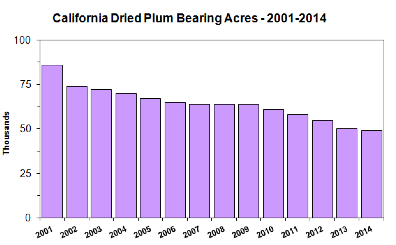
Prune Crop Up 12 Percent / Acreage Down
The 2014 California dried plum (prune) crop is forecast at 95 thousand tons, up
12 percent from the 85 thousand tons produced in 2013. Total 2014 bearing
acreage is estimated at 49,000. Dried plum trees were pulled after the 2013
harvest, reducing acreage by 2 percent for the 2014 season. The French prune
variety accounts for virtually all dried plum acreage grown in California. The
production forecast is based on a survey of dried plum growers conducted by the
USDA, NASS, Pacific Regional Office from May 6-27, 2014.
Mites May Be Issue In Bee Deaths
from Quartz
Finally, some good news from the frontlines of the beeapocalypse: Significantly fewer
honey bees died in the winter of 2013-2014 in the US than in previous years, according to a survey released today. Better yet, scientists think they know a simple way to minimize the devastation that has led to a $10 billion die-off of bees that pollinate one-third of the world’s food supply.
A host of factors have been fingered as culprits in bee deaths—from pesticides and a dearth of nutritious food to stress and even automotive exhaust. But researchers at the University of Maryland found that a well-known bee parasite, the Varroa mite, was the No. 1 killer last winter. “Our field data suggests mites are playing a very large role here,” Dennis vanEngelsdorp, a University of Maryland entomology professor who led the study, told Quartz.