
Construction Boom Expected
June 4,2014
Looking to meet state renewable energy requirements as well federal tax credit deadlines – a number of 20MW utility-size solar projects in the Central Valley are being built this summer and some very large ones expect to get underway by the end of the year.
A 30% federal tax credit will expire in 2016 lighting a fire under developers aiming to finish their multi-million dollar projects in time to collect.
If the developers are in a hurry, so is the California PUC – pushing the private utilities like PG&E to add the infrastructure to hook the arrays up to the grid and carry the power across the Valley in many cases.
The PUC is being driven by a state mandate to increase renewable energy generation to 33% in California by 2020 to cut carbon pollution.
Dry and spent farmland in the Central Valley is now growing panels instead of crops
The timetable means over the next year and a half the Central Valley is likely to see a rush of solar panel construction across this sun drenched, four-county region from Kern to Tulare,Kings and Fresno counties, mostly on its western edge.
Not only is utility-size solar construction cooking, residential roof-top solar building permits in the Central Valley are blistering with year-to-date numbers more than double what they were during the same time last year, which was a busy year.
More than 2600 residential solar power permits have been issued so far this year in Madera,Kings,Fresno Tulare and Kern counties says Construction Monitor.
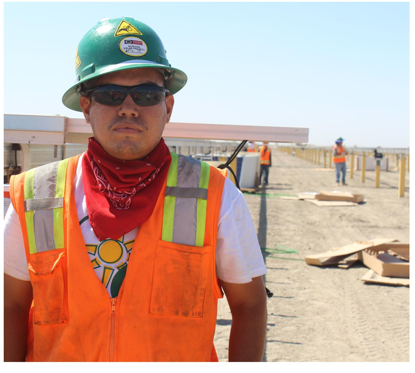
Nobody is watching the uptick in construction closer than Hector Uriarte Jr who works as leader of a job training program based in Visalia ”We were told one company – First Solar was looking for 600 workers to help build three solar plants this summer “ says Uriarte who is Proteus’s green jobs coordinator.The plants are being built in Kings and Fresno counties. The job training program offers a course in solar panel installation in Visalia and now they plan to open a Delano office to develop a green workforce in Kern County.
Some Valley developers like ImModo target smaller 1 to 7 MW utility-size projects (and under construction now) while others aim at a 20MW size, each with an advantage of time to construction over the mega solar projects that seem to take forever to happen.
The wait is for government permits, financing as well as power purchase agreements from a utility like PG&E. The big projects have an incredibly long lead time (and uncertainty) before they can pop the champagne.
700MW Project
Case in point is Fresno-based Granville Homes, owned by the Assemi family. Jeff Roberts, the company’s VP says they have been working five long years to be able to build a large 700MW project in southwest Kern County but are now near the finish line,he expects.
“We just got approval for the first solar Habitat Conservation Plan anywhere” says Roberts, noting there is a 90 day comment period through the US Fish and Wildlife Service before it is final. The plan is in compliance with the Endangered Species Act. ”Doing all this is not for a the feint of heart” he advises.
With all permits in place – the project – Maricopa Sun, is near ready to go to construction with the first two 150MW phases having already been sold to German utility E.ON who who wants to break ground by years end says Roberts. E.On is one of the largest utilities in Europe. The company reworked their business plan to switch to renewables after the German decision in 2011 to close all their nuclear power plants by 2022. Now the utility is focusing on growth markets around the world – like California.
The sprawling 6000 acre project was “actually Plan B” for this relatively flat farmland, says Roberts.”But with no water we decided to move forward on solar.” The land has been without a water supply for 10 years. The energy project has been well received, getting all permits in Kern County, moving out of the Williamson Act and even getting the support of the Sierra Club. The land near Taft is remote but close to where PGE can hook into the state power grid.In a CPUC notice in May, PGE has promised to begin the hook up process in September and be complete with power poll construction by December.
At build out, 700 MW Maricopa Sun would be one of the largest solar projects in the US.
Another large project nears ground breaking as well in Fresno County.
That is Recurrent Energy’s Tranquility Solar, a 3732 acre, 400 MW solar farm, 5.5 miles east of I-5 in Westlands Water District. The huge project’s draft EIR will be the subject of a public meeting June 25 says Fresno County planner Briza Grace Scholars. She adds that the company is eager to start building by the end of 2014 or early 2015.
The Tranquility project was originally proposed in 2011 but the company pulled the application in 2012. Now it’s back and Recurrent, who has a good record of building what they propose, is likely to move forward this winter. The Tranquility project could boast as many as 2.5 million PV panels and be worth perhaps three quarters of a billion dollars.
The project includes a switching station approved by the California Public Utilities Commission and owned and operated by PG&E.
Water Issue:
Some criticize large solar projects on farm land pointing the loss of prime ag land as an issue. “Much of the solar development is proposed for Kern, Tulare, Fresno and Kings counties, which are home to more than 400 crops that pump $30 billion into the economy and help sustain U.S. food security” cautions a recent Huffington Post article.
But the argument ignores the fact that almost all the the projects are located on non-prime land in areas like the Westlands Water District where the soils are salt and selenium laden and never will be farmed again.They are classified as “retired” farm land by the US government.
What Slow Down?
While some argue that the heyday of major solar development is fading (LA Times “Solar prospects now aren’t as sunny”). Indeed there are far fewer pending projects from a few years ago when 10 projects were proposed for every one built – but the numbers now are still impressive.
Just consider one fact. As of March of this year – solar provided a record 18 percent of California’s 22,700 megawatt (MW) demand. That’s just the solar part of the renewables. Add in the wind and hydro generation and there is steady progress in reaching the 33% renewables goal. Now EPA will be mandating a 30% cut in carbon emissions nationwide news reports say.
Since 2003, 7,627 MW of renewable generation capacity has achieved commercial operation under the state RPS program. More than 2,769 MW of renewable generation capacity came online in 2013, and another 2,721 MW of capacity is forecasted to reach commercial operation by the end of 2014. These numbers are the equivalent of adding the generation capacity of a Diablo Nuclear Power plant to the grid each year.
More mega projects in the Valley are still being actively worked on -notably Westland Solar Park – a 2300MW behemoth, a phased project in the Westlands WD in Kings County, also right off the Avenal Cutoff Rd. More news coming on this soon.
Also around Tulare,Fresno,Kern and Kings counties the panels are going up on a number of 20 to 100 MW solar farms. They include:
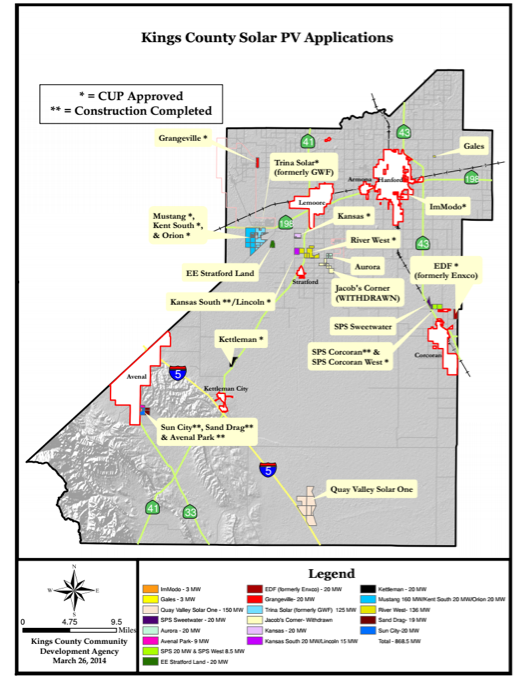 – Earlier this spring Richmond, Va-based energy firm Dominion announced it has purchased six local solar development projects from Recurrent Energy, one of North America’s largest developers of utility scale solar projects.Recurrent continues to develop solar projects in the Central Valley it will likely sell off once completed.The solar project sites are located in Fresno, Kern and Kings counties.
The projects, all with power purchase agreements in place, include the 34-megawatt Adams East project near Tranquility in Fresno County; Kent South, a 20-megawatt solar farm near Lemoore in Kings County and the 27-megawatt Kansas solar farm, also near Lemoore. Three more are in Kern County — Old River, Camelot and Colombia 2. Together they add up to 139 megawatts of output. All are being built or will be built in the next year.
To hook up a number of Recurrent projects in Kings County the developer is now building a new 2.7-acre 70 kilovolt switching station which it will transfer the ownership to PG&E when complete. The switching station is located approximately 150 feet northwest of the intersection of Avenal Cutoff Road and 25th Avenue. Construction started in May 2014.
– Recurrent also plans to build RE Mustang LLC – a 160 Megawatt solar photovoltaic energy facility located at 15866 25th Avenue, Lemoore, CA. The big project is one of several being proposed by the SF-based Recurrent Energy, owned by Sharp, a Japanese firm. The site is near the NAS Lemoore base.
–Henrietta Solar Project. Bids to build this 100MW solar farm owned by Bay Area-based SunPower will be taken in December for construction in 2015 says a report. The project is near the NAS Lemoore base in Kings County.
– First Solar plans to build 42.76MW for EDF Renewable Energy – a French owned firm.First Solar and EDF Renewable Energy have signed EPC agreements for the 19.76 Megawatt AC CID Solar Project, located in Corcoran in Kings County; and the 23MWAC Cottonwood Solar Project, consisting of two sites, one located in Kings County and the other in Kern County. The CID Solar Project has a Power Purchase Agreement with Pacific Gas and Electric Company. The Cottonwood project has a PPA with Marin Clean Energy.
Construction on these projects is expected to begin in the second quarter of 2014, with CID Solar anticipated completion in October 2014 and Cottonwood anticipated completion in the first quarter of 2015.
-Kern county has another major project going to construction on its western edge – Lost Hills Solar. Last year First Solar and and the City of Roseville, California announced they have signed a power purchase agreement (PPA) for 32MW of solar electricity to be generated at the Lost Hills photovoltaic power plant that First Solar is developing and will construct in Kern County. Construction is underway now. The site is near Hwys 33 and 46 with PG&E building a facility this October to accommodate the power hookup according to the PUC.
Alos in Kern County’s Valley region – SunEdison, North America’s largest solar energy services provider, is developing a 75 MW solar photovoltaic system . The system will be located on a 743-acre site about 11 miles southeast of Bakersfield, California. This project will likely move forward by 2015 as well.
-In Tulare County, Spanish-backed Immodo has been building 5 smaller 1 to 7MW solar projects investing more than $40 million. Now it is close to building solar facilities in Porterville and Farmersville and near Hanford. Local spokesman Don Watson says the company plans to remain in the county because of opportunity in the ag sector to build more business here. The county’s PACE program promises low cost financing. Now the city of Visalia has joined that program.
More in Tulare County: This week New York-based ConEd purchased another 20MW project with plans approved but yet to be constructed in the Alpaugh area. Several ConEd projects nearby already produce more than 70MW in this remote western part of the county. Another 20MW project there is already under construction.
One large 80MW project remains in the pipeline in Tulare County. The project site is located east of State Route 65 and south of Avenue 24.
PG&E Line Will Carry New Supply
A proposed Central Valley Power Connect project would span about 70 miles through Kings, Fresno and Madera Counties, connecting two existing PG&E substations, one east of Coalinga and the other north of Fresno. PG&E is partnering with MidAmerican Transmission and Citizens Energy on the project. MidAmerican owns a large solar project in SLO County. The Central Valley Power Connect is a proposed new 230,000 volt (230kV) electric transmission line connecting Gates Substation east of Coalinga and Gregg Substation northwest of Fresno. The California Independent System Operator (CAISO) estimates the cost to be approximately $115 to $145 million .
The line is needed to meet the growing demand for electricity in the Central Valley region, ensure that the Helms Pumped Storage hydroelectric Plant can continue to deliver clean, affordable electricity to nearly 900,000 average homes well into the future, and help integrate renewable solar and wind power onto the electric grid.