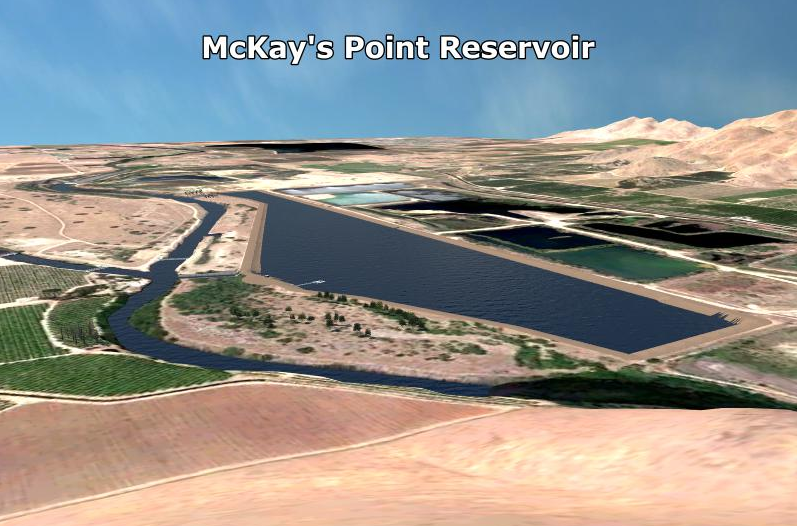
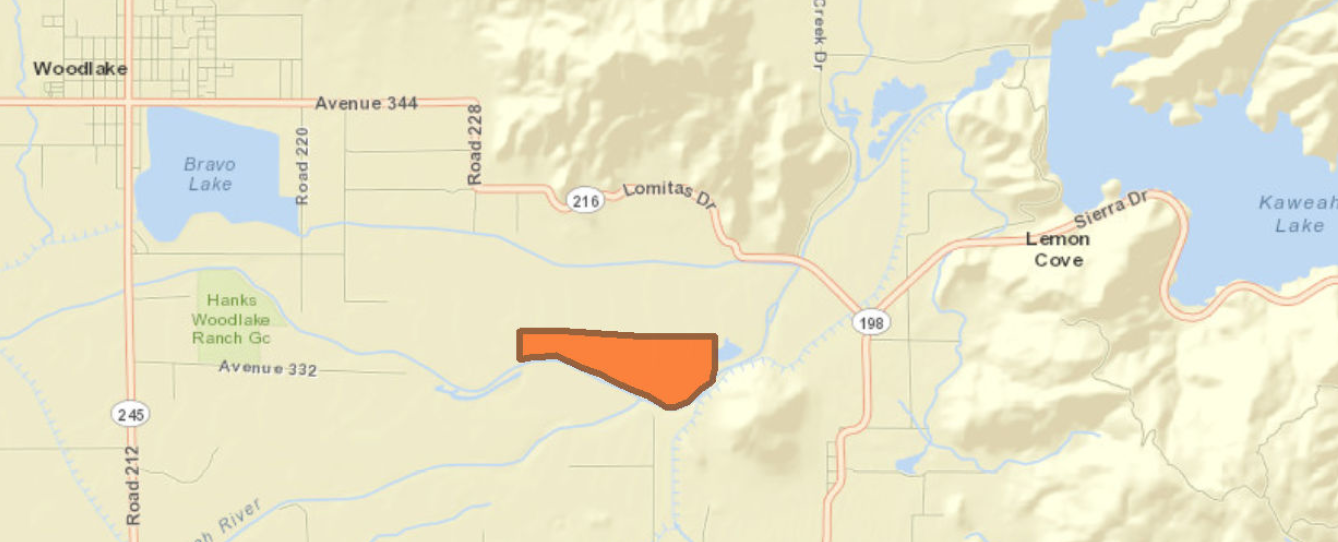
 TULARE – A new reservoir is proposed at McKay Point, near Lemon Cove and Woodlake, to provide new water storage, flood control and potential power generation.
The project is a joint venture of property owners Tulare Irrigation District, the
Consolidated Peoples Ditch Company and the Visalia & Kaweah Water Company.
CEMEX, an aggregates and building materials company with long-established local operations, will excavate the reservoir site and sell the materials. The owners will then receive a royalty on the sale of materials, which provides revenue that should make
the project financially feasible, explained Paul Hendrix, general manager of the Tulare Irrigation District.
Hendrix says the permitting on the big project could take a year or more and any utilization of the site to store water could come some 5 years later ”It will take 10 years or longer for the whole the whole site to be be ready” says Hendrix. Cemex will take that long to complete excavation and processing of product at their nearby Lemon Cove plant. Cemex is a worldwide building product company based in Mexico.
A series of public hearings will be held to allow Tulare Irrigation District to gather public
input on elements that residents feel need to be considered in the Environmental Impact
Report. Public comments must be submitted by Feb. 27.
The hearings will be held:
• Tuesday, Feb. 18, 5:30 p.m., Woodlake Council Chambers, 350 N. Valencia Blvd.
• Wednesday, Feb. 19, 1:30 p.m., Visalia Convention Center, 303 E. Acequia, Visalia
• Wednesday, Feb. 19, 5:30 p.m., Tulare Irrigation District Office, 6826 Ave. 240, Tulare
The key components of the project are:
• More efficient capture and distribution of water for ag use. The new reservoir,
and its water control features, will allow for water to be captured and more efficiently
distributed for agricultural use, when farmers need it. Currently, during times of flood
release from Terminus Dam, water not immediately needed is diverted to groundwater
recharge basins or discharged to the historic Tulare Lake Bed. The reservoir will allow
for increased upstream storage of this water.
• Flood control. During wet years, water will be diverted into the reservoir, thereby
lessening the risk of water backing up into the streets of downtown Visalia. Water would
be returned to the Lower Kaweah and the St. Johns rivers when it is safe and beneficial to do so.
• Power generation. The hydroelectric generators at the Terminus Dam outlets at Lake
Kaweah will be able to produce more power, especially during times of peak demand,
once the McKay Point reservoir is available. The resulting clean power may provide
revenue to support the maintenance of the reservoir and other projects as needed to
ensure continued delivery of water to support agriculture.
 In coordination with this project Kaweah Power Authority that includes TID is planning to construct a 3 to5 MW hydroelectric plant that will generate power when the lake is low. As of now the existing 21 MW plant cannot generate power from May through September when the lake is drawn down.
• More water for local use. During wet years, floodwater from the Kaweah River, Dry
Creek and Yokohl Creek typically floods farmland and/or is diverted to the Friant-Kern
Canal for disposal in the Kern River near Bakersfield (assuming the Kern River has
capacity). The McKay Point Reservoir will capture some of this floodwater and hold it
until it can be safely released back into the Kaweah and St. Johns rivers for immediate
use or for groundwater recharge.
“The reservoir and its new water control structures will significantly improve how we
capture, store and distribute water,” Hendrix noted. “The partnership with CEMEX is
necessary in order for the owners to deliver an important service to the region at virtually no cost to the general public.”
The reservoir itself, to be located north of the separation of the Kaweah and St. Johns
rivers, is expected to take about 120 acres of the jointly owned 500 acres.
“McKay Point meets a real need,” Hendrix added. “It is an excellent example of
responsible and resourceful management of energy and water. In this increasingly water- short region, finding new ways to make good use of wet-year water and flood flows is critically important.”
