
Valley Economic Group Hears Report June 21 On Monterey Shale
Hanford:The California Partnership For The San Joaquin Valley will meet in Hanford June 21 to hear an expert panel on economic development forecasts including the potential for taping the Monterey Shale oil patch, some 10,000 feet below the ground in the Central Valley.
The partnership chaired by Fresno mayor Ashley Swearengin will gather from 10 AM to 3PM June 21 at the Hanford Civic Auditorium. Speakers include Diane Friend from the Kings County Farm Bureau,Darrel Pyle City Manager of Hanford and Kings EDC president John Lehn.
Among the guest on the panel discussing the issue will be Nick Ortiz,head of the industry group Western States Petroleum Assn.(WSPA) in Bakersfield who will speak about the group’s view that tapping the oil reserve could bring big revenues to Kings County.
According to the EIA, there are as many as 15.4 billion barrels trapped inside shale rock – more than four times the Bakken Shale in North Dakota undergoing a boom right now.
A USC study of the potential here – released in March said “the prudent development of the Monterey Shale could add hundreds of thousands of new jobs to California over the next decade while stimulating economic growth and generating significant new state and local tax revenues.”
“The trick is to unlock the deposits” says WSPA rep Nick Ortiz.
That requires use of fracturing technology that Oritiz says the public has a right to know about and ask questions.
“The petroleum industry voluntarily discloses how much water and what chemicals are used and where fracking is happening on the website fracfocus.org”
WSPA has argued for the potential benefits of California’s Monterey Shale – a 1,700 square mile oil-bearing shale formation primarily in the San Joaquin Valley from Kern to Merced counties and includes Kings County. That recent report from USC said tapping the oil over period from 2015 – 2030 could:
Create from 512,000 to 2.8 million new jobs;
Increase California’s gross domestic product (GDP) by 2.6 percent to 14.3 percent on a per-person basis;
Grow personal income by an average of 2.1 percent to 10 percent;
Generate $4.5 billion to $24.6 billion in new tax revenues for state and local government services.
This opportunity has not escaped the notice of Governor Jerry Brown, who recently said he is confident his oil and gas regulators can and will protect the environment so hydraulic fracturing can unlock the “extraordinary” opportunities offered by the Monterey’s massive oil deposits.
Despite these promising developments, there are still those who would like to ban or restrict the practice of hydraulic fracturing based on claims of risk to the environment and water quality.Hydraulic fracturing is the fracturing of rock by a pressurized liquid. The process is used on an estimated 60% of new wells but remains relatively unregulated.
Governor Brown said, it is imperative the safety of hydraulic fracturing “be decided based on science, based on common sense and based on a deliberative process that listens to people – but also wants to take advantage of the opportunities we have in this state.
Indeed supporters say a comprehensive regulatory package will sufficiently ensure that our state’s environmental health and natural resources are protected while safely using hydraulic fracturing technologies for oil production in California, including:
Pre-notification and submission of information to the Department of Oil, Gas and Geothermal Resources (DOGGR) prior to beginning hydraulic fracturing operations
Additional groundwater testing
Expanded testing of the structural integrity of wells to prevent fluid migration
Well monitoring before and after the conclusion of hydraulic fracturing operations
Full disclosure of the chemicals used in hydraulic fracturing.
While some would like to ban fracking because of the potential to hurt ground water with the chemicals they use injected in the ground, others like former Kings Supervisor Tony Oliveira favor regulation along with a small severance tax.
“California is the only major oil producing state that does not charge a severance tax.” he notes. Other oil states impose a tax on extraction including Alaska at 12.25%, Louisiana 12.5%, Oklahoma 7%, Kansas 8%, Colorado5% over a minimum payment, Texas 4.6% and Wyoming 6%.
In the past month the issue surfaced in the California State Senate with some Democrats pushing for a 9.5% severance tax. The bill failed but now there is a student-led ballot initiative for 2014 circulating that is proposing the same rate.
Oliveira says he believes the Governor who supports fracking would back a smaller oil severance tax ”perhaps 3 to 4%” and predicts that will likely be what happens
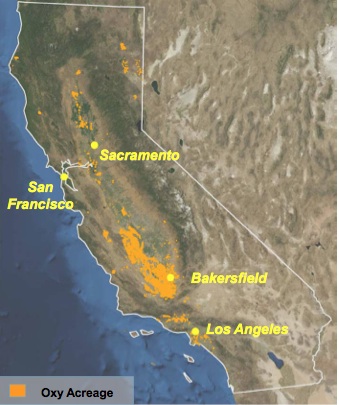
A Wall Street report says Occidental petroleum that now controls some 1.2 million acres in the Monterey Shale is the big player here with more acreage than all other companies combined. The report adds that OXY will spend $6.3 billion to develop those lands over the next four years predicting that by 2015 the company will produce 25% of tie revenues from these new fields.
The report calls the Monterey Shale “ the biggest thing to hit California since the Gold Rush.”
Oliveira who offers that he has business dealings with OXY – leases on family owned land – says while the state won’t stop fracking some small extraction tax may be warranted. Olveira says the tax could benefit cash strapped Kings County if it were structured right.
Like Brown Oliveira,a Democrat and economist, sees big benefits here saying the Monterey Shale as “worth $1 trillion dollars to the Valley in the next 30 years.”
What about water required to do the injections in a water-short Valley?
Oliveira points to the perched water supply under the Westlands Water District for example with its 35 million acre feet of salt leaden water that could be used and reclaimed with new desal’ techniques.
A proposed hydrogen plant in Kern County will be using some 7,500 acre feet of brackish water per year.