
Local dairy farmers are getting mixed messages from the marketplace. As more processing plants open in the Midwest and Texas, there are fewer buyers for local milk production. Kings county dairyman Joqaquin Contente says when Leprino closed their Lemoore East plant “farmers lost 80 loads of milk” that means dairies no longer had a” home” for some volume of production. That is happening even as California milk production is up 2.3% and farmers continue to add cows here and nationwide.
So what’s happening?
If there is too much milk, milk co-ops are trying to tap down the volume this spring when production typically ramps up, says the Daily Dairy Report.The report says in the April 17 release that “in California, milk is abundant, and dryers are running as hard as possible. As the spring flush overwhelms processing capacity, a major California cooperative is incentivizing producers to rein in milk output with steep discounts on any milk shipped above their monthly base volume. Last year, avian influenza dragged down California milk output and national NDM and skim milk powder (SMP) production slumped to a 12-year low. The California comeback matters. Last year, despite the bird flu, the Golden State accounted for 44% of U.S. NDMoutput.Now that California’s cows are healthy and happy again, production is up. U.S. milk powder output topped 2024 and 2025 volumes in January and February.”
Contente says he believes all the milk co-ops are exercising production controls, helping to keep prices profitable and penalizing overproduction.
Highest price ever
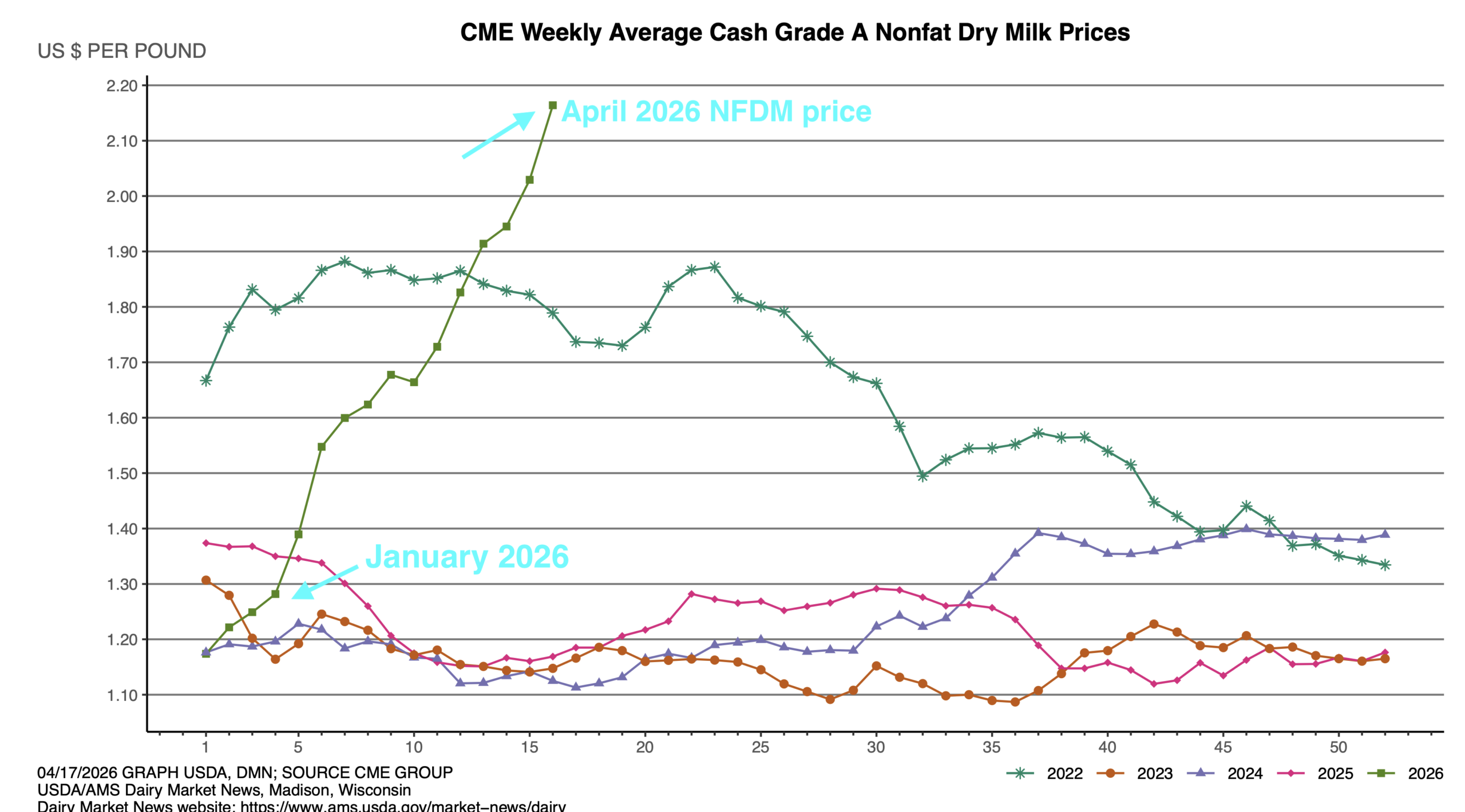
The co-ops appear to be succeeding. The nonfat dry milk (NFDM) price has run up in the past month to the highest price ever at $2.25 a pound today,more than a dollar higher than average on the CME cash market.The last time nonfat dry milk traded above two dollars per pound was in July of 2022.The run-up in price can be seen from the first of the year when the price was more typical at $1.17 lb. It’s almost doubled since then, highly unusual.
The high prices are benefiting the cooperative California Dairies, one of the biggest players in NDFM sales in the US. With headquarters and a big processing plant in Visalia, California Dairies Inc. (CDI), is the largest member-owned milk marketing and processing cooperative in California. They make some 900 million pounds of milk powder annually.The cooperative is co-owned by more than 300 dairy families. California Dairies markets milk powder both domestically and globally. Established in 1995, their DairyAmerica brand has command of approximately 50% of all milk powder produced in the US and is exported to 50 countries.
Processing milk requires high heat to remove the water content and at the CDI plant in Visalia they employ solar thermal heat for the dryers from a thousand solar collectors on the roof of their plant.Use of solar technology cuts the pollution from the plant installed in 2022.
So if there is too much milk, why are NFDM prices skyrocketing?
It seems likely that like other food and drink sectors there are real positive and negative impacts as Americans are shifting consumption choices,many of us on diets.In the case of some ag commodities, demand has dropped including for wine,beer, bread and high carb foods, many snacks and calorie-dense foods like potatoes.
About one in every eight U.S. adults is currently taking a GLP-1 drug, like Ozempic or Zepbound, according to the KFF Health Tracking Poll. Food industry surveys find a negative impact on consumption of fried chicken, fast food, bacon, sausage, pizza, and sugary foods and drinks like soda, candy, pastries, and desserts Since we are eating less pasta and pizza, tomato paste is impacted.All Together, this is a huge portion of the US food industry.

On the plus side, demand for high protein foods like milk powder that is used as an ingredient in hundreds of food products is suddenly very popular as a base for hot sellers like nutritional beverages, ultrafiltered milk and milk protein concentrate. NDFM is still used for sales to countries with little refrigeration like Mexico where about a third of our milk powders are sold.
Social media impact
Demand for protein seems to have a similar benefit for milk producers for formerly sleepy products like cottage cheese also now enjoying a boom. One report says “cottage cheese is experiencing a massive, social-media-driven resurgence (a 65% sales increase since 2021), transforming from a dated diet food into a trendy, high-protein staple. Driven by Gen Z on TikTok, it is celebrated for its versatility, high protein with 12g per serving) and creamy texture when blended.”
Also boosting dairy farmers profits is the generics-led Beef- on-Dairy trend that led to more animals on the farm. The Dairy Report notes ” It is remarkable that producers continued to add cows during the challenging margin period at the turn of the year and this dynamic suggests that other sources of income, such as beef sales, had a fundamental impact on producer decision making”
Demand for beef and high prices has propelled dairymen to convert some of their herd to beef, sending their young male calves to area calf ranches that do a big business with both beef animals and young future milk cows.
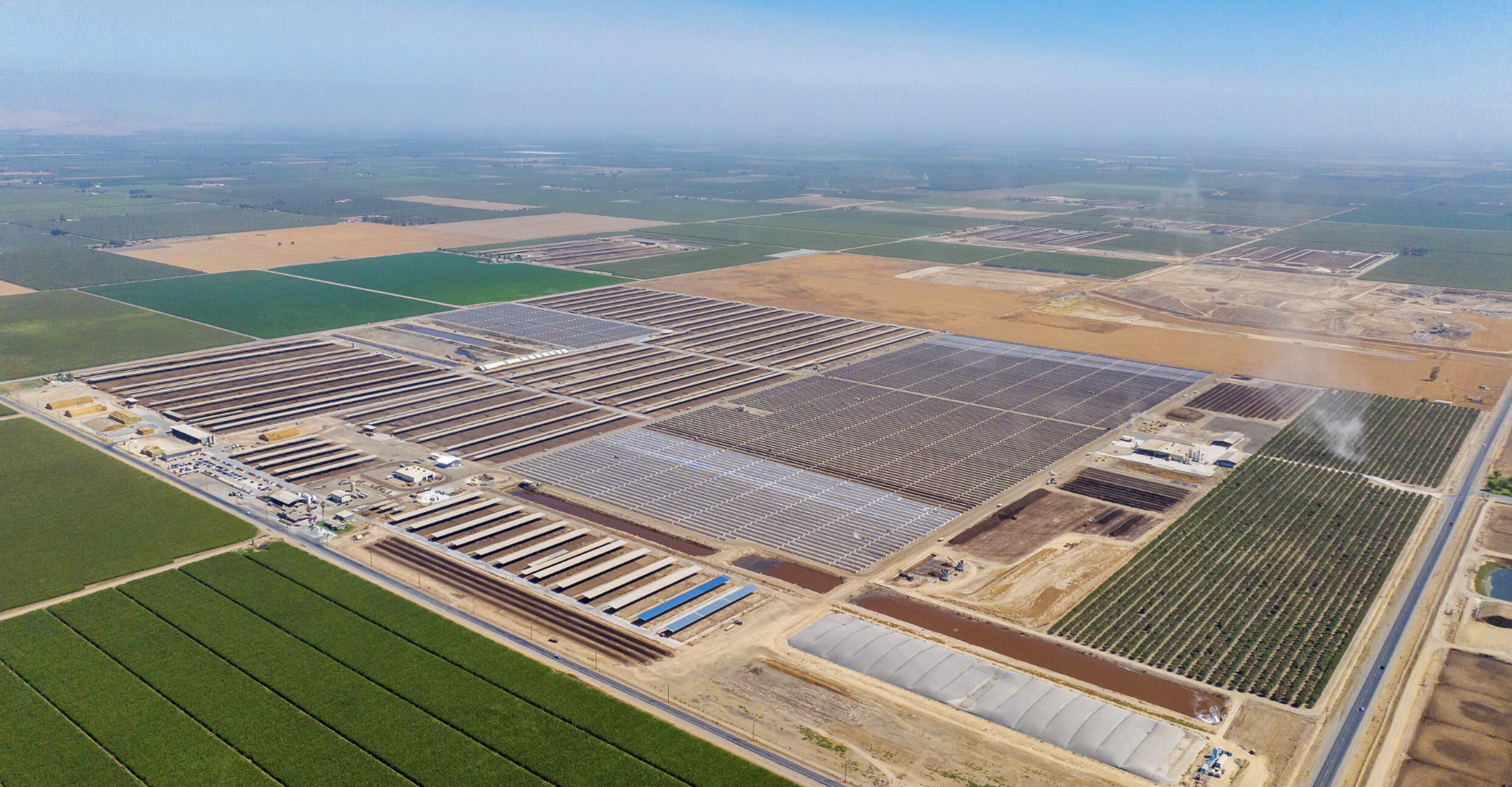
Kings County calf ranch
An industry report comments “By 2026, the dairy barn has effectively become the factory floor for the beef industry. Because a dairy cow calves every day of the year, the integrator (the dairy producer) can provide a steady, predictable stream of high-quality protein to the packer every single week. There is no calf crop season. There is only a continuous, scheduled flow.”
The trend is nationwide, says the American Farm Bureau. “Beef-on-dairy crossbreeding is the latest step in the evolution of dairy genetics and is now a key driver of the U.S. supply of both beef and dairy cattle. Some 72% of dairy farms are now incorporating beef genetics into their breeding programs, enhancing the marketability of dairy-origin calves by improving carcass quality and feed efficiency — traits highly valued by feedlots and packers. Crossbreeding, along with the widespread use of sexed semen, is helping stabilize beef supply while creating a reliable revenue stream for dairy producers.”
Beef-on-dairy crossbreeding uses beef semen like Angus on dairy cows to produce higher value calves.