
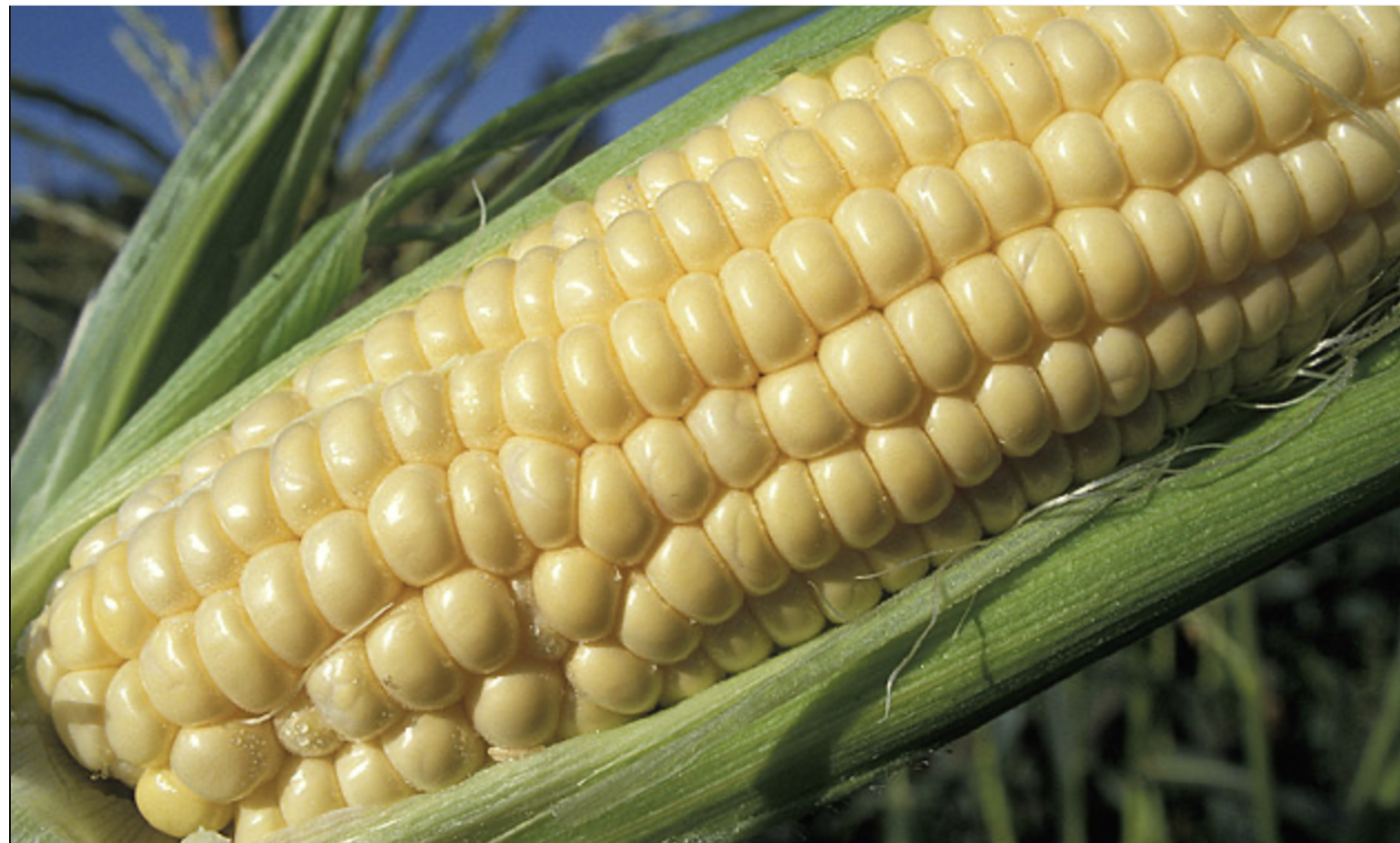
Farmers are a productive bunch harvesting more corn per acre than ever. Ditto for many other crops
Water not the only factor farmers face in search of profit. Sometimes fewer acres are a plus
Listen to famers who worry that harvesting fewer acres due to requirements to pump less water with SGMA or receiving less surface water will result in big economic losses for both them and for the region’s economy. The cries are among the loudest from regions like western Fresno County where few natural water supplies exist including Westlands Water District.
But there are other factors in the discussion in search of profitability.
In multiple crops, farmers are far more efficient and productive year after year producing more corn and soybeans per acre, more milk per cow, more processing tomatoes with less water and a drop in labor needs.
Focus on yields for example.
Case in point is the California avocado industry that has seen its bearing acreage decline from 76,000 acres in 1988 to 49,000 acres in 2025. Does that mean we’re producing a whole bunch less avocados or that the industry is suffering economically?
Comparing 1989 to 2025 the avocado industry may have shrunk by 25% in terms of acres harvested but they produced 325.6 million pounds of avocados in 2025 compared to just 271 million pounds on more acres in 1989.
Statistics from the California avocado growers say the value of their crop in 2025 was $9562 per acre compared to $3233 in 1989.
California avocado farmers are harvesting more than triple the number of pounds of avocados per-acre compared to 1989. More production on less acreage. By the way, they taste way better than Mexico’s huge avocado volume and that contrast helps California sales.
Now take a big crop grown here in the Central Valley – processing tomatoes – a tangy source for your salsa and pasta sauce.
In 2025 the California Tomato Growers Association said they had a bountiful tomato crop with an average yield of 55 tons per acre – an all time record eclipsing the 2018 record of 52.1 tons per acre.
At the same time, acreage under contract to processors in 2025 was just 200,000 statewide, the lowest contracted amount on record back to 1975. Acreage is down from 300,000 acres in 1975 and because of technology like drip irrigation, farmers use less water to produce their 11 million ton crop, Processors have a leash on farmers to keep from growing more because that is all they can sell! Like many other crops, managing volume, limiting it, helps keep the price paid to growers profitable.
Dairy more efficient
An even bigger crop in the Valley is milk. Here too, farmers are more efficient in large part due to scientific breakthroughs in milk production testing, first launched in 1905, resulting in breed associations and artificial insemination.All that leads to higher volume cows. In modern times, production of milk per cow has improved from around 13,000lbs in 1960 to over 24,000lbs annually today.
Meanwhile there are far fewer cows than in decades past. In the year 1900 the census found 37 million cows one year old or more.Today there’s about 9.5 million cows in the US.
Those 9.5 million cows produce around 228 billion pounds of milk – almost three times as much milk with half as many cows compared to 1920.The latest figures from USDA says the industry is boosting production up 4.2% year over year as of September.
Back in 1920, milking machines were starting to appear, but hand milking of 8-10 cows remained a standard for a single worker. Pasteurization, leading to safer milk, helped reinforce the growth of the industry based on increasing consumer confidence.
Today constant improvement in the handling of milk on the farm has lessened the spoilage factor by reducing the somatic cell count that leads to decay. Science in action.
In recent years, the annual average production per cow has increased nearly every year. Overall production is up around 10% in the past decade. But now larger herds are leading to a dramatic drop in what dairymen are being paid for their milk due to what has been called a “gush” of milk in the marketplace.”Got Too Much Milk”. See chart of how much milk prices are down just this year to red ink levels.
Like in a number of crops, dairy farmers manage their volume through self-organized dairy cooperatives like California Dairies Inc and Dairy Farmers of America.USDA notes that in 2022, there were 89 dairy cooperatives in the United States, accounting for 87% of the market share for U.S. milk and milk products.The co-op manages flow of milk after it leaves the farm “balancing” the supply between products based on whether it can sell or not.
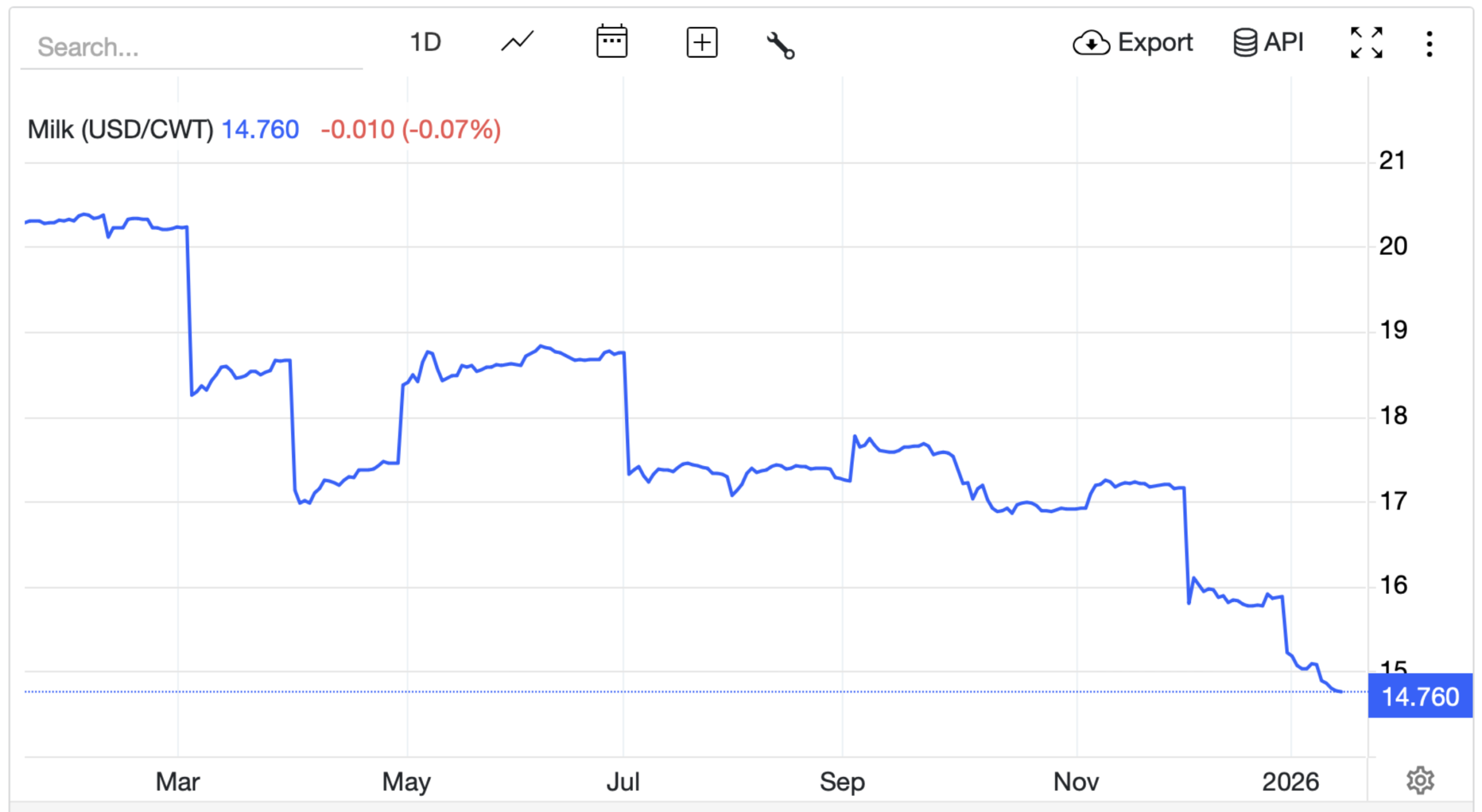
Co-ops adapt to market demand by shifting production between fluid milk, cheese or powders to handle perishability and price fluctuations. Co-op uses incentives for its members including penalizing excess production with lower pay as well as creating market programs that discourage oversupply.
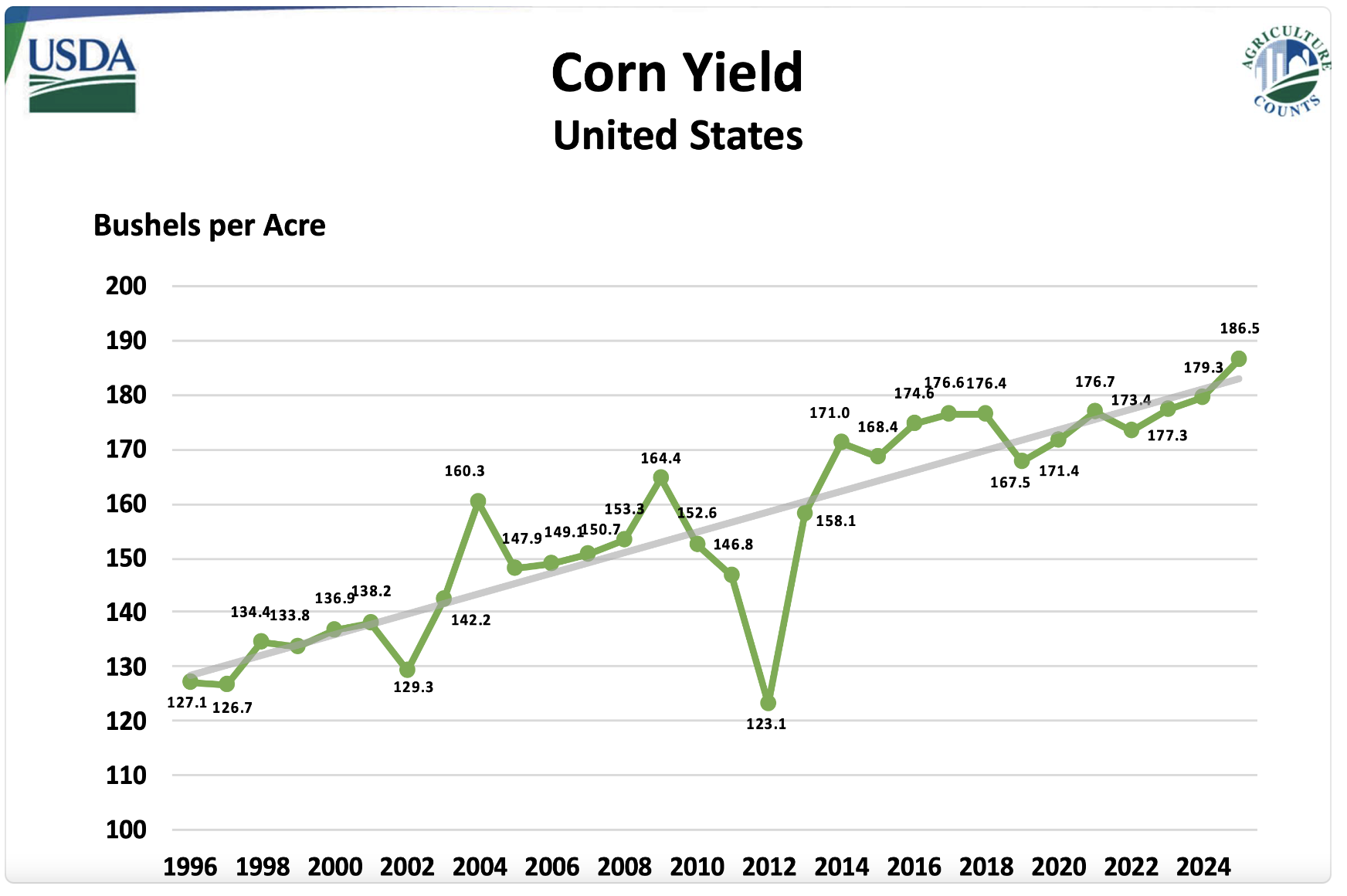
Speaking of too much of a commodity, both corn and soybeans, the nation’s largest crops, are in surplus right now based in part on President Trump’s tariff policy and retaliation from China and others who now choose to buy key food commodities from other countries instead of our farmers.
Both big crops have seen a dramatic increase in yields according to USDA.
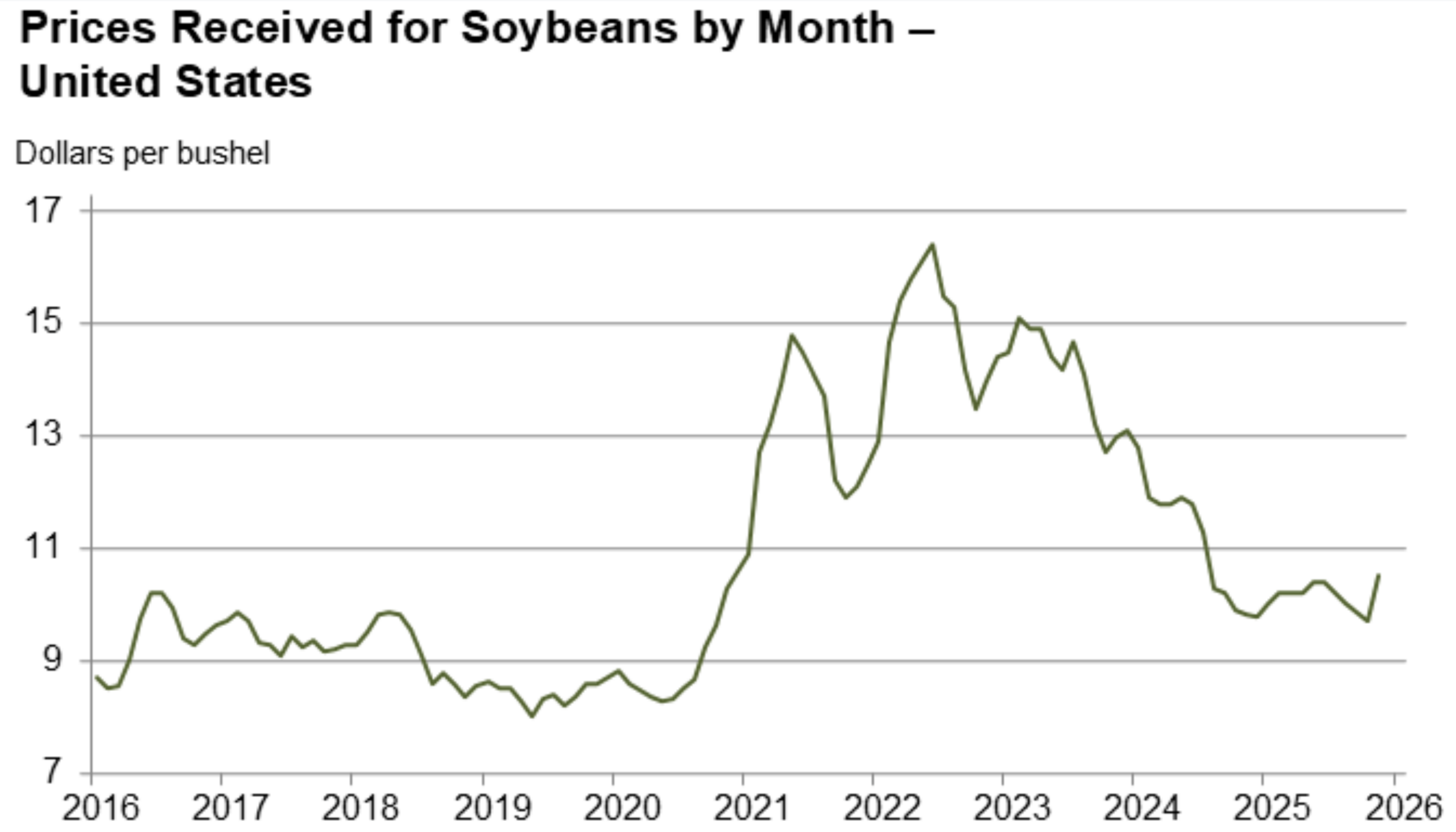
This year the Midwest soybean crop has seen record yields in Iowa, Minnesota, and Wisconsin, despite reduced total area compared to 2024, with an average yield of about 53.5 bushels per acre.
But the average price paid to farmers has seen a downward trend.
The Trump administration has offered a subsidy of $30.88/acre for soybeans, but the American Soybean Assn argues that it “will not cover the significant financial damage soybean farmers sustained this year due to the high cost of production and losses sustained during the China trade war.”
Back in California, the nation’s largest water district Westlands Water District has been very vocal in their argument that less water delivered to farmers is leading to lower incomes and regional economic damage including job losses.
They say that because of lower surface water deliveries there has been a fallowing of 200,000 acres in the sprawling westside district.
But water is not the only factor.
Westland publishes an annual crop report that shows over a 10 year period , 206,000 acres were idled in 2014 compared to 199,000 acres and 2024-about the same.
Fewer acres not a death knell
Westland farmers planted 42,000 acres of processing tomatoes in 2024 down from 67,000 acres in 2014 reflecting more production from fewer acres. In Fresno County the annual county crop report shows that back in 2000, farmers planted 95,000 acres of processing tomatoes. But the latest report for 2024 says we have a much bigger tonnage with about 55% of the acreage.
Although Westlands complains about lower revenue, Fresno County’s latest crop report for 2024 shows farmers generated $9 billion in sales in the nation’s biggest ag county, an all-time record. Farm receipts in Westlands itself are not published and like Fresno County as a whole – crop revenue is likely up- not down.
That crop report shows in Fresno County processing tomato acreage was 64,000 acres with a yield of 59 tons per acre and sales of $429 million in 2024.In 2018 Fresno County acreage was 77,140 acres with a yield of 52 tons per acre and a value of $296 million. So growers managed to make more money from 17% less land and that is 17% less land that needed to be irrigated, saving that water for someone else.
Of course costs are up too, especially in California as been widely reported.
As wages have climbed there has been a huge change in the cropping pattern in the Westland’s district, reducing the need for hand labor to harvest the crop when vegetable fields are converted to tree nuts that are harvested mechanically.
In 2000 Westlands had 19,000 acres of almonds. But by 2014 acreage had grown to 82,000 acres. It then dropped to 73,000 acres in 2024 following a trend statewide of reducing almond acreage in an effort to increase per pound price. It has been widely reported that the almond industry in California was in overproduction mode.
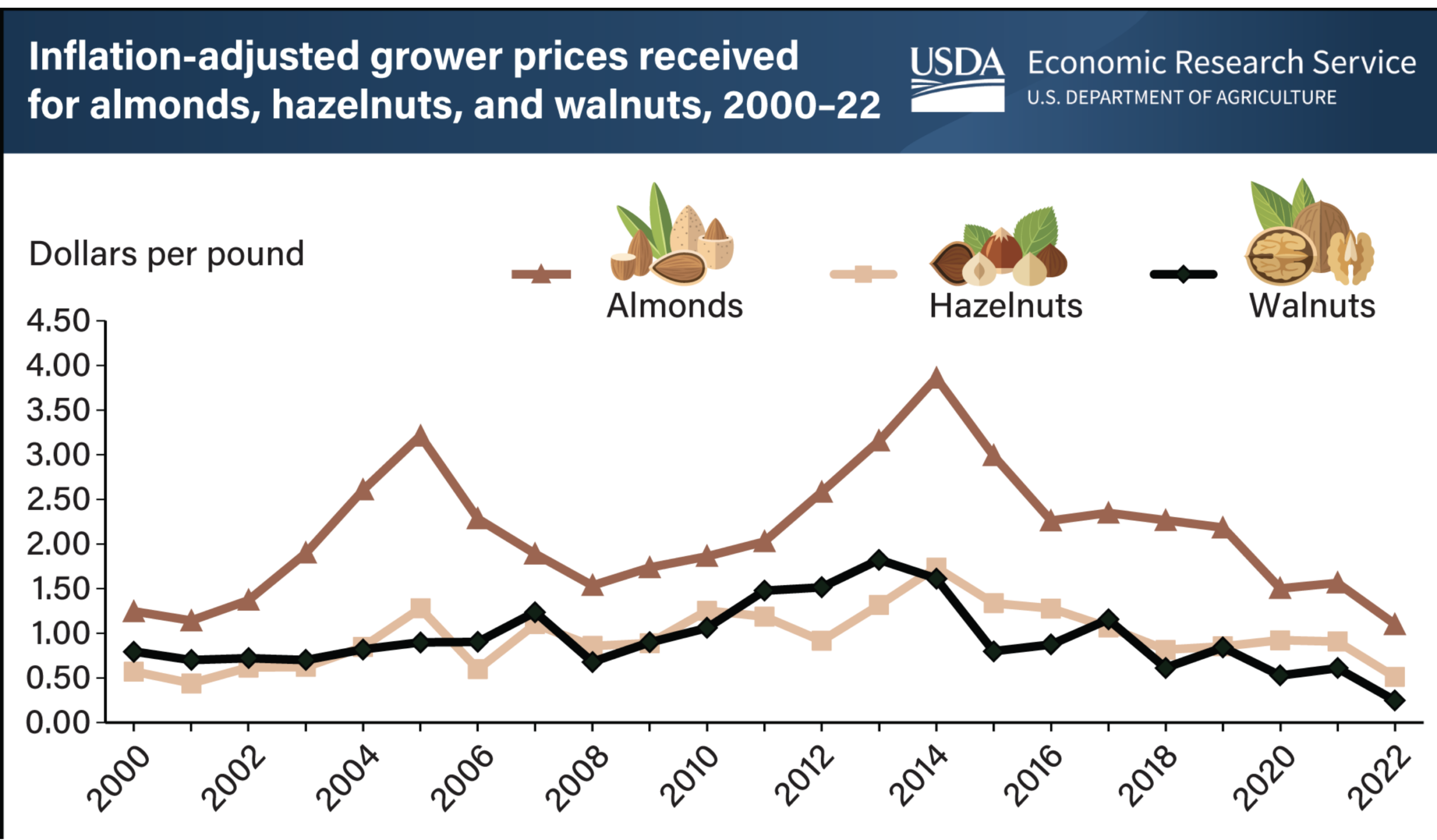
The upshot – reducing acreage helps lift the price for the whole group.Prices in 2025 have gone up to about $2.50 per pound.
There has been another major crop conversion in Westlands. In 2000 the district had just 5000 acres of pistachios, climbing to 34,000 acres in 2014 and 85,000 acres in 2024. Unlike almonds, pistachios are still selling well with farmers getting an average $2.10 per pound as world ‘s consumers can’t get enough. But the crop expansion certainly has reduced the need for farm labor in the district.
What about grapes?
In 2000 Westlands grew about 10,000 acres of grapes, mostly wine grapes according to their published crop report. In 2014 that grew to 18,000 acres. As of 2024 wine grapes acres were back down to 10,200 as district farmers fallowed unprofitable vines. Grape industry leaders have and still are arguing that growers need to pull acreage to reflect lower demand seen in the marketplace.Jeff Bitter, president of the Fresno-based Allied Grape Growers has told growers recently “the pain doesn’t go away,” he said, “until grapes go away.” Water is not the only issue.You have to have a customer to buy the stuff and fewer people are drinking wine and some are not drinking at all.
One huge crop has almost gone away here thanks to worldwide competition and a US surplus- a realty as big a factor as water. We are talking about cotton. Westlands grew 180,000 acres of upland cotton in 2000 reflecting a state that once grew a million acres of the fiber. In Westlands in 2024 the farmers there looked elsewhere for profit harvesting just 4,000 acres of upland- a 97% decline.
Lots of jobs were lost with scores of cotton gins all over the Valley going out of business.Water and drought were an issue for sure,but so was global competition, consumer taste for synthetic fibers and the prospect of better returns from nuts. Meanwhile, most US cotton that competes with Valley cotton is grown from rainfall. Farmers from other states don’t have to pay for water.Then there is price. The average price of upland cotton today hovers around 60 cents. USDA says this year global production is up nearly 1 percent year-over-year but consumption is flat.Like other US crops – yields are up around 15% in the past decade, says USDA. The upshot – there is a decline in cotton growing acres and that may not be a bad thing.
Westlands consultant Michael A. Shires, Ph.D, has highlighted two themes, including one that says less water delivered to the district has resulted in less economic activity and fewer jobs in the area.
Back in 2014 the same consultant report pointed out that crop choices made by farmers in the district have resulted in conversion from labor intensive, hand-harvested crops to permanent plantings like nut trees. That has resulted in a decline in jobs. So it’s not just water.
Professor Shires 2016 study found ” the share of permanent crops within the district has risen dramatically— from less than 10 percent of crops in 2000, to 25 percent in 2011 to just under 50 percent in 2015. This has both short and long-term implications for employment within the region as farmers shift away from labor-intensive produce to invest in tree nut and wine grape crops. Both of these crops have very different long-term labor demands.”
The consultant published a chart that shows between 1993 and 2015 the shift to permanent crops in the district resulted in a decline from 10,000 jobs in 1993 down to 6000 in 2015.The study found a total effect including indirect job loss of 10,700 positions.Clearly there are other issues that affect the region’s bottom line.
Farm work in grapes has declined in a dramatic way in Fresno County in the past few decades based on a grower conversion to dried-on-the-vine raisins that use mechanical harvesting. The industry used 50,000 to 60,000 workers during harvest time in the 1990s when there were 270,000 acres that needed hand labor. Farmers found that there wasn’t enough labor to get the work done.Now the labor needed to harvest raisins requires just 10,000 to 15,000 workers as acreage has shrunk from 280,000 in 2000 to 90,000 acres statewide.
Statistics show that Fresno County grew 171,000 acres of raisin grapes in the year 2000, By 2019 raisin acreage in the county dropped to 82,000. Now in 2025 the county’s raisin industry has shrunk to 68,000 acres, once Fresno’s claim to fame. While you could claim water as a factor – it is consumer behavior that appears to be more important with consumption in the U.S. showing a long-term downward trend. Consumption dropped from a peak of over 2 pounds per person in the late 1980s to around 1.2-1.3 pounds annually due to competition from fresh fruit and other dried fruits. California growers compete with global exporters including Turkey, Iran, and Chile, supplying international markets like Europe. Again growing these grapes is not just a water supply issue.
The last factor that needs discussion, but not mentioned in the Westlands studies, is the fact that the location in this otherwise dry landscape is totally dependent on outside water supplies shipped in from far away with few local natural waterways. How farmers have managed this water supply has led to soil high in salt and other impurities like selenium that poisoned wildlife in ponding basins some years back. Soil health is a big issue in Westlands Water District.
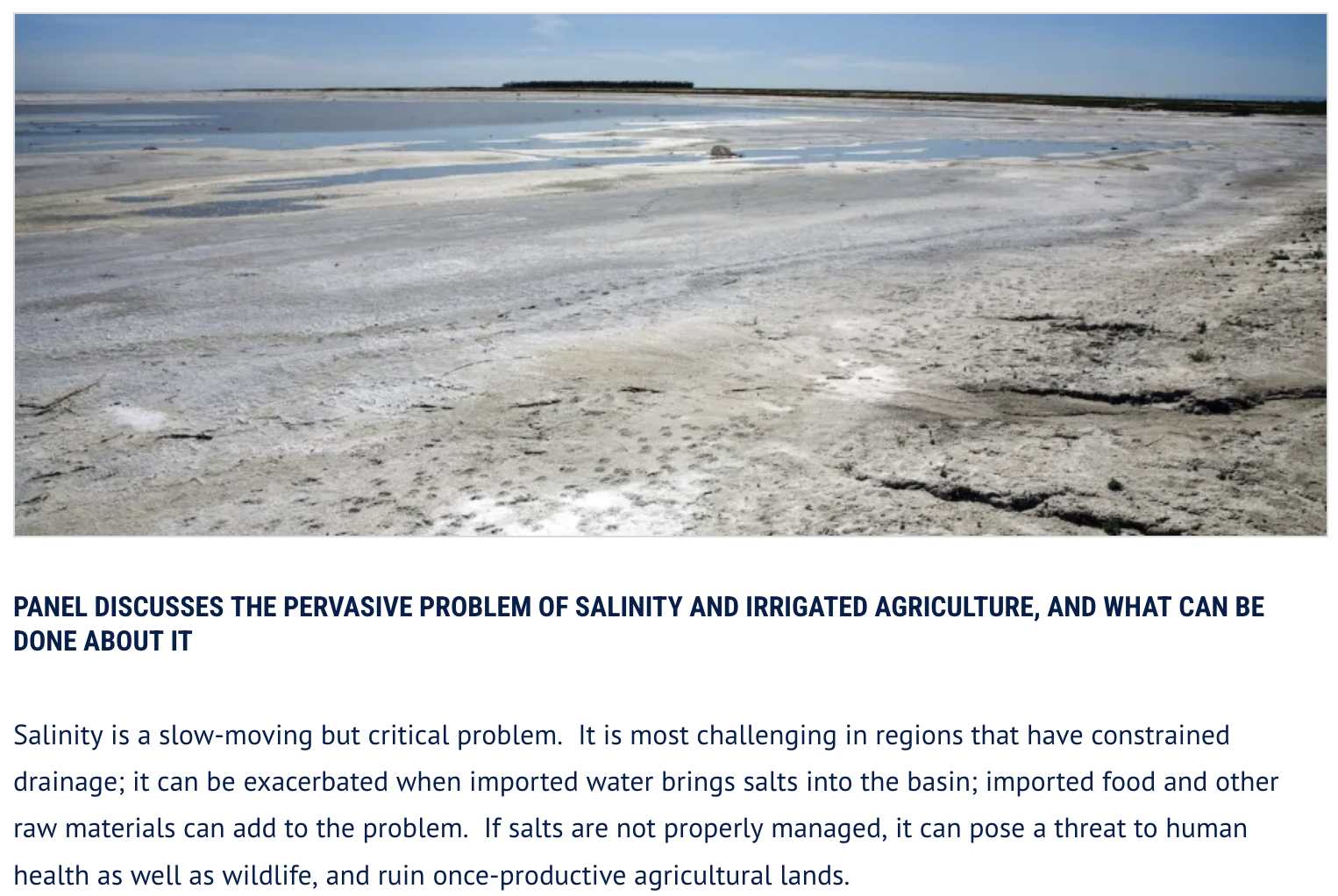
From Mavens Notebook-water blog
What are we talking about?-Naturally Occurring Salts: Soils in the region naturally contain high levels of salts and boron, remnants of an ancient inland sea that once covered the area.-Inadequate Drainage: A low-permeability layer of clay known as the Corcoran clay, present beneath the surface, impedes the downward percolation of water, leading to a shallow water table and the accumulation of salts.-Irrigation Practices: The introduction of large-scale irrigated agriculture, coupled with the use of saltier imported water from the Central Valley Project, exacerbated the issue. Over time, irrigation water evaporates, leaving the salts behind in the soil and groundwater.-Lack of Freshwater: A lack of sufficient freshwater supply and rainfall to naturally flush the salts through the soil profile has intensified the problem. The upshot is that salinity threatens the long-term viability of agriculture in the region. High salt concentrations can damage crops, reduce yields, and in severe cases, render land unsuitable for farming.
Collapsing canals
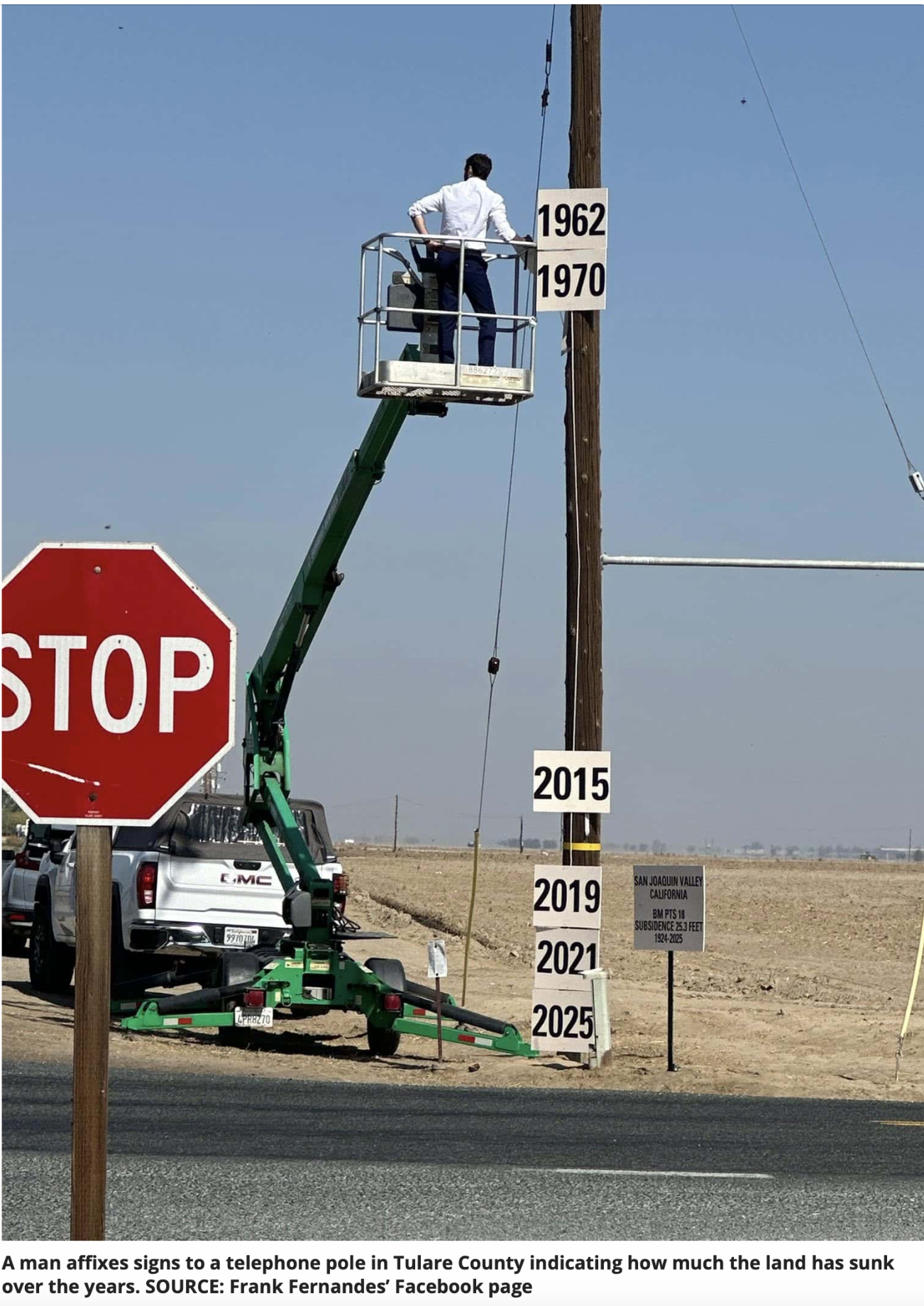
Still more threats. Farmers say they needed to pump more groundwater in recent decades because of drought and they claim – flawed water policy. That has led to subsidence in this area damaging the very water infrastructure farmers need to bring in water from northern California. It will take estimates of over $4 billion to repair collapsing canals like the California Aqueduct that supplies Westlands and Friant Kern Canal on the eastside.At a recent almond grower seminar, Paul Gosselin, deputy director at the California Department of Water Resources noted that capacity in the westside’s California Aqueduct was predicted to decline by 87% if subsidence was not corrected. That would devastate supplies for Kern County and the farmers that depend on those supplies.He did not mention LA, but Metropolitan WD is a major beneficiary. But with a price tag for a fix amounting to billions of dollars, who should pay?
Should public pay?
Here is the answer quoting from a recent article in an ag publication.
“Nursery owner John Duarte argued that even if the farmers caused the problem, they simply do not have the capacity to pay.Duarte was direct in where the blame lies – subsidence is a direct result of failed environmental policies that depleted surface water supplies and forced farmers to turn to groundwater. On those grounds, the state and federal governments have the obligation to fix the choke points in the conveyance systems,” he maintains, reflecting farmers’ view.
The huge aqueduct delivers water not just to Westlands, but farms and cities to the south through the State Water Project including millions of people in LA.
Farming kilowatts
So it is not surprising that the Westland’s Board of Directors recently approved a plan to develop 136,000 acres of fallowed land to be dedicated to building the nation’s largest solar farm producing kilowatts instead of cotton. The plan will mean both new income on what is idled land and water savings. The Valley Clean Infrastructure Plan calls for building up to 21 gigawatts of solar energy and an equivalent amount of battery storage on along with a series of high-voltage transmission lines to connect the electricity generated to the state’s grid.The project will take up to a decade to be completed. and could provide a quarter of the state’s clean energy needs by 2035. The developer is the same group that is building Westlands Solar Park in Kings County._________