
Your electric power costs keep climbing says Trump’s energy agency
Overall U.S. wholesale electricity prices are expected to continue rising next year, the US Energy Information Administration said in its latest short-term energy outlook, published this month.
The agency forecast the load-weighted average of the 11 regional wholesale prices it tracks to be $47/MWh in 2025 — 23% higher than the 2024 average — and to reach $51/MWh in 2026, another 8.5% increase.
Driving the rise in wholesale prices next year is primarily a projected 45% increase at the Electric Reliability Council of Texas-North pricing hub. “Natural gas prices tend to be the biggest determinant of power prices,” the EIA said. “But in 2026, the increase in power prices in ERCOT tends to reflect large hourly spikes in the summer months due to high demand combined with relatively low supply in this region.”
A solar/battery project looks to offset hefty electric bills at wastewater facility
Officials at the Rincon del Diablo Municipal Water District in the past week formally unveiled plans to build a solar canopy array and battery energy storage project at the Harmony Grove Village Water Reclamation Facility in Escondido Calif. The reclamation facility runs up a power bill of about $5,000 each month and the solar-plus-battery project will help offset the wastewater treatment center’s energy costs.The 302-kilowatt solar array with 559 panels atop a canopy will generate electricity to help run the treatment facility that recycles more than 180,000 gallons of wastewater on a daily basis.The solar-plus-battery project expects to break ground next month and is scheduled to be up and running by next summer.
Clint Baze, the water district’s general manager, said the project will cost about $3.2 million, but a $1.2 million grant from the federal government’s Inflation Reduction Act will reduce the overall price tag.“After 20 years, it will pay for itself,” Baze said, given the anticipated savings on the treatment plant’s monthly electric bills.-San Diego Union
Is U.S. Gasoline Consumption Declining?
Electric vehicles and other factors are leading drivers to use less gasoline.
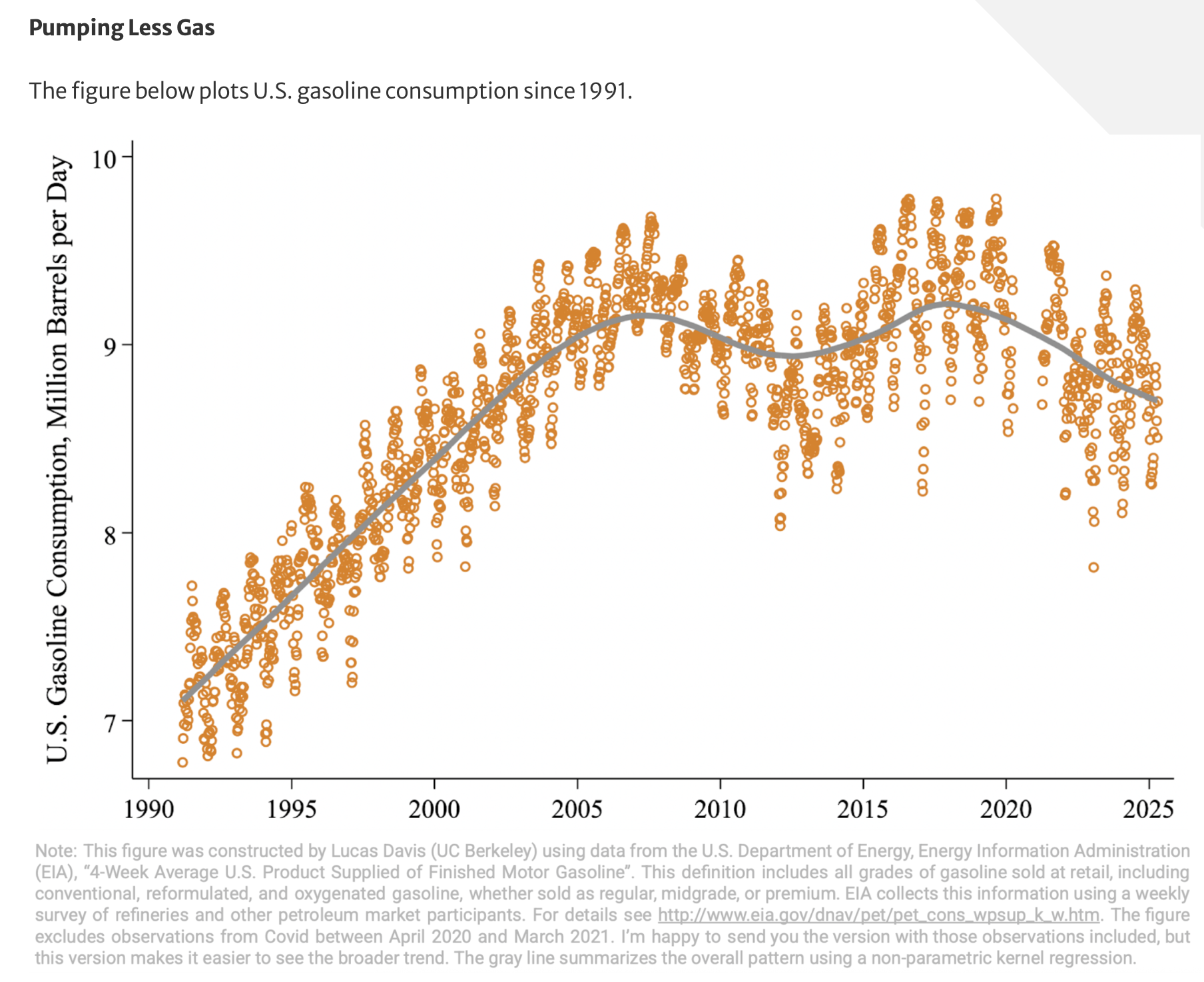
U.S. Gasoline consumption has increased steadily for decades. Between 1945 and 2007, there were 54 years with gasoline consumption increases, and only 9 years with gasoline consumption decreases. There really has been only one direction – up, and up, and up.
But that trend has changed recently. For today’s blog, I want to dig into the data on U.S. gasoline consumption. The U.S. population keeps growing, light trucks and SUVs are more popular than ever, and gasoline prices have mostly been below $4 per gallon. So you might have expected continued growth.
Yet for the last six years, U.S. gasoline consumption has trended downward. The overall decline is modest (about 5%), but stands in sharp contrast to previous decades, and is widespread across four-of-five U.S. regions.
It is always hard to know whether trends like this will continue, but it makes more sense to me now why refinery owners are cautious about the future, and why policymakers are scrambling to make up for lost gas tax revenues.-Energy Institute Blog