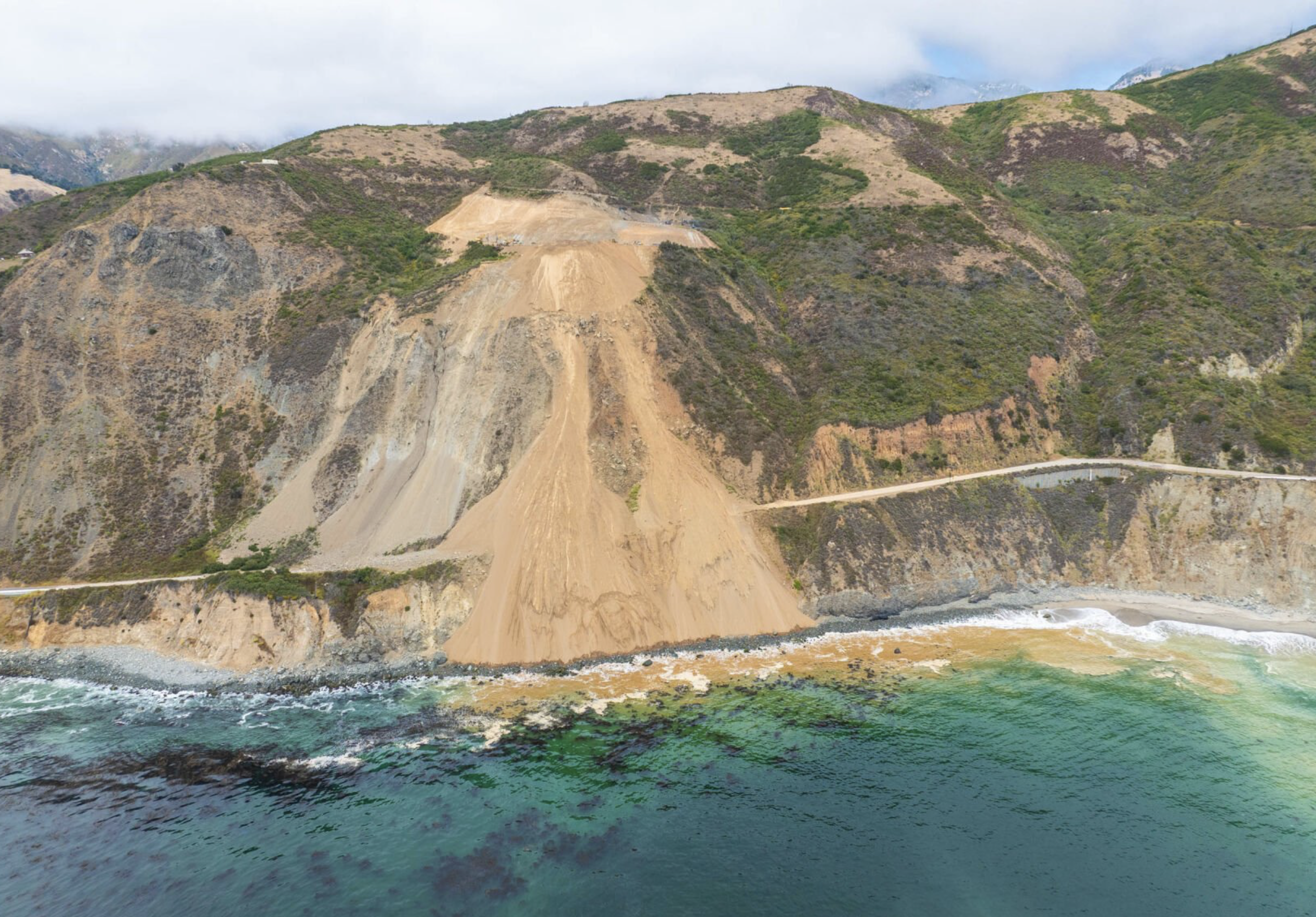
Landslides closed Highway 1 along the world famous Big Sur coast, severing the flow of travelers, and reducing the amount of economic activity, mostly tourist spending, by roughly $312 million between 2023 and 2024 says the state agency Visit California and LA-based Beacon Economics in a recently published study.
Local city and county governments have lost over $27 million in tax revenue during these two years.
Meanwhile the highway remains closed today and is causing $13 to $14 million in economic losses per month, equaling a total of $438 million since the first slide occurred in January 2023.
Late March opening date
Now Caltrans just announced repairs to the road will be complete next year allowing the highway to open for thru traffic by the end of March 2026 assuming no new winter damage in coming months. Landslides have become a money pit for the state spending hundreds of millions of dollars as vigorous wet stormsand its location on fault lines have increased periodic damage to the cliffside highway.
Landslides closed Highway 1 in 2017 but the Covid shutdown also reduced traffic in 20/21 compounding the multi-year economic impacts in recent years.
On January 14, 2023, a major landslide buried a stretch of Highway 1 in Lucia, near Big Sur, on California’s central coast. Before Caltrans could repair the damage, a second major slide occurred six miles north of the first one. As of September 2025, a 6.8 mile stretch of the road remains closed, with reconstruction still underway.
The Beacon Economics study says the small towns of San Simeon and Big Sur experienced the steepest proportional losses. Over the two years, visitor spending at San Simeon dropped 42% relative to baseline expectations.
In 2022, tourists spent roughly $27 million in San Simeon. If the road had remained open, it’s expected this number would have risen slightly to $29M. Instead, nature buried the highway under half a million cubic yards of debris, and tourist spending dropped to $17 million in 2023 and $17 million in 2024.
Near San Simeon is Hearst Castle, a vast estate built by newspaper magnate William Randolph Hearst
between 1919 and 1947. Visitation at the castle—now a museum and California State Park—fell from 222,500
during the summer of 2022, to 184,000 during the summer of 2023.
For Big Sur, the road closure resulted in a total loss of $33 million in visitor spending, reflecting a decline of 20% from baseline expectations for 2023 and 2024. This was driven by their respective isolation and dependency on the Highway, and hotel managers in the area reported having to close segments of their businesses. In a news article the GM of the resort restaurant Nepenthe says they have about a third fewer customers than usual.
Monterey hard hit
In absolute terms, the City of Monterey is home to the largest tourism economy in the region, representing nearly
60% of total tourism spending annually. Similarly, the City of Monterey also endured the largest loss of visitor
spending, losing $145 million over the two years as compared to baseline expectations, says the report.
Likewise in San Luis Obispo County’s Morro Bay and Cambria, visitor spending dropped about 10% from where it was expected to be without the closures, says the study.