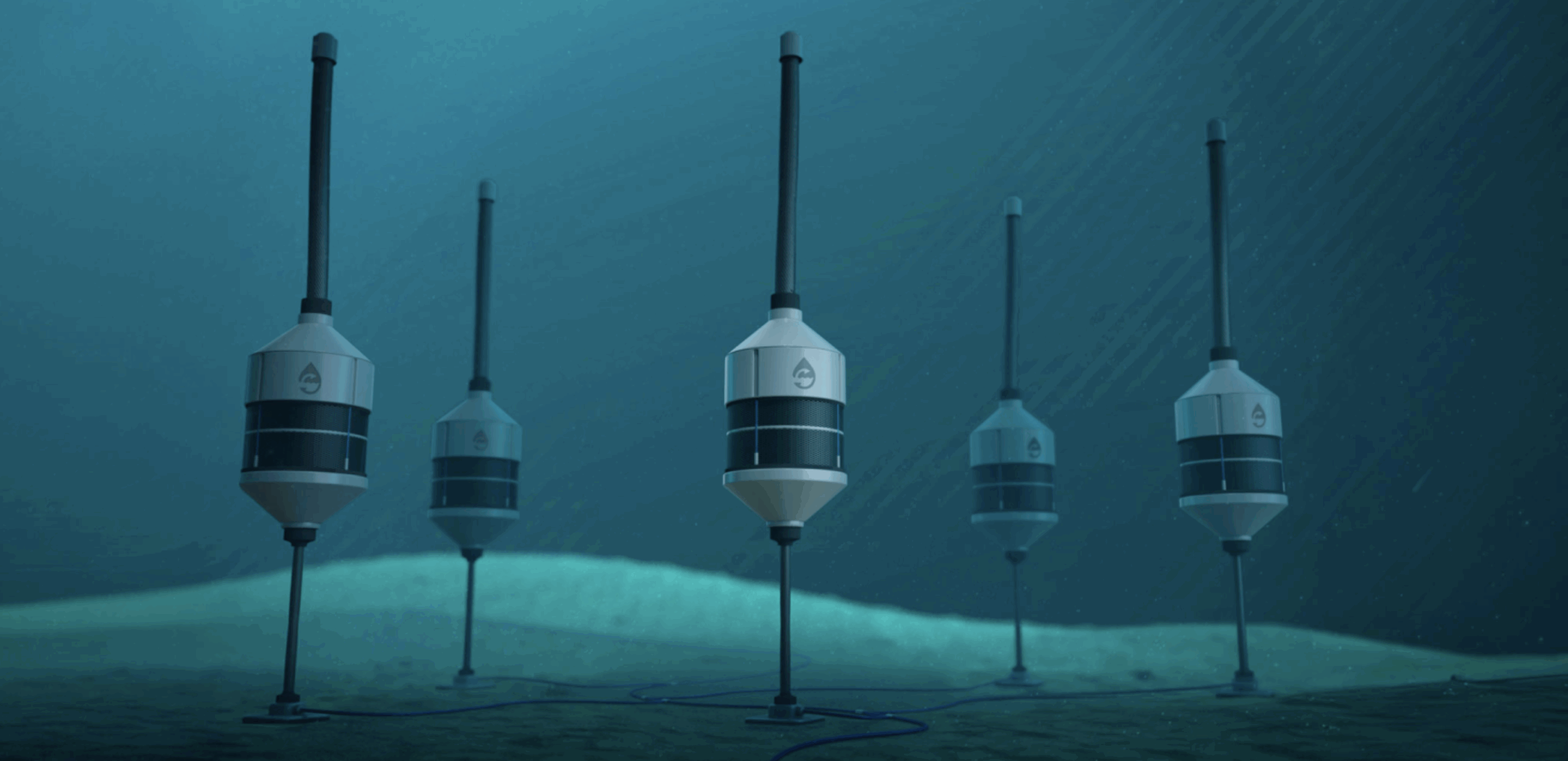
OceanWell sub sea pods
The world is running out of fresh water and now companies are using the high pressure of the ocean depths to push seawater through a membrane leaving salt behind.This month Scientific American reports a breakthrough in strategy of how to apply reverse osmosis without huge energy costs or negative environmental issues by allowing it to” happen naturally” – using technology that harnesses pressure hundreds of meters underwater.
“Reverse osmosis pods are submerged to depths of around 400 to 500 meters (1,600 feet) where immense hydrostatic pressure does the heavy lifting of separating water from salt. Purified water is then pumped back to shore. Far-fetched as it may sound, there are multiple prototypes already at work; the companies behind them aim to take cheap, large-scale desalination from pipe dream to reality.”
One such company with big but achievable pipe dreams for the California Coast is SF-based OceanWell who announced a pioneer project called Water Farm1 (WF-1) with six LA area water agencies this month. The desalination project would pump 60 million gallons per day to drought-prone Southern California by 2030. That would be about 66,000 acre-feet annually, enough to supply some 15 cities the size of San Luis Obispo. The desal pods would be anchored 4.5 miles off the coast of Malibu in Santa Monica Bay.
“California, like much of the world, urgently needs a new source of water to replace dwindling supplies,” said Robert Bergstrom, CEO of OceanWell. “Water Farm 1 shows how we can responsibly and economically harvest fresh water from the ocean by building infrastructure to withstand rapidly melting snowpack, increasing drought, more extreme atmospheric rivers, sea water intrusion, and overdrawn groundwater. Water Farm 1 is a critical milestone toward OceanWell’s goal of adding one million acre-feet of new potable water to the global supply within a decade.”
This spring OceanWell demonstrated the pods in Las Virgenes Reservoir near Calabasa to high acclaim of the water agency leaders gathered there. Las Virgenes manages water for 70,000 SoCal residents.
Looking past the Malibu water farm, OceanWell is close to testing the technology in six north-to-south locations offshore from Cayucos in San Luis Obispo County to around Pt Arguello and down to Pt Hueneme and south to Dana Point and then off Carlsbad under a permit being issued by the EPA. OceanWell has said it is aiming at 15 water farms in California and elsewhere.So far Oceanwell supported by a working group of 25 thirsty California water agencies.
The complaints against current and past desalination projects include high energy consumption, environmental impacts like brine discharge as well as marine life disruption and high costs.Importantly, the Coastal Commission has opposed on-land desal projects. Lack of scale and low volume also haunt existing projects. For example, problems with the Santa Barbara 1990s desal operation include limited capacity of just 3,125 acre-feet per year (20x smaller than the WF-1) requiring 13.8 million kilowatt hours of electricity per year, or 4,416 kilowatt hours per acre foot. This is 42 percent more electricity than it takes to import water from the State Water Project (3,100 kWh/AF).
Land infrastructure can’t deliver
The State Water Project ships water over 700 miles from northern California along the Central Coast to San Luis Obispo County and Morro Bay, Santa Maria, Santa Barbara and south to LA and beyond – all told 29 public agencies and local water districts from Plumas County in the north to San Diego County in the south. But that supply is in jeopardy due to climate change, suggest a number of studies.California is expected to lose 10% of its water supply by 2040 due to climate change, and the State Water Project could lose up to 46% of its delivery capability as land subsidence threatens canal infrastructure. Now a new study this week says if no action is taken, it could fall up to 87% by 2043 affecting 21 million Californians, says DWR.
If there is trouble to the north, LA also has problems importing water from the east – big time.
Los Angeles is dependent on imported water from the Colorado River- the source of about one-third of Southern California’s water supply. Again climate change is impacting rainfall in the Southwest as well as California with Lake Mead predicted to reach the lowest level ever in the next two years. Published research has found that” the Colorado River Basin’s current “megadrought” is the worst dry spell the region has experienced in at least 1,200 years. “
“WF-1 offers a new model that reduces pressure on strained systems like California’s Bay-Delta system and the Colorado River and unsustainable aquifer extraction, helping secure a more resilient, climate-aligned water future,” OceanWell observes.
Collaboration key

Water policy expert Tim Quinn, who knows everyone in the California water world, spent 40 years in the business including ten years as the executive director of the Association of California Water Agencies and more than twenty years as the Deputy General Manager of the Metropolitan Water District of Southern California. Over the course of that career, he was at the center of every major water management issue facing the state of California, including the state’s use of Colorado River water, management of the Bay-Delta, and sustainable groundwater management. After retiring from ACWA, Mr. Quinn became a Landreth Visiting Fellow at Stanford University, where he wrote a white paper titled Forty Years of California Water Policy. Quinn says a”valuable general lesson from that 40-year career is that collaboration works and conflict doesn’t. I learned this by reaching across silo boundaries hundreds of times during my career.”
Bringing his work history up to date, Quinn says as result of publishing that paper he got a call from Robert Bergstrom – currently CEO of OceanWell. “Now I am an employee of OceanWell” says Quinn, adding that he believes this technology is the “most promising water development since the California Aqueduct.”
Construction of the aqueduct launched in the late 1950s delivers water to 27 million people and irrigates some 750,000 acres of farms. It is a key conveyance for the State Water Project that delivers water derived from Northern California snow melt through the Delta to much drier SoCal.
Look West
Quinn remarks that in the past, Southern California “has looked north and east for a water supply and now it’s time to look west” to the ocean for the future.
If some of these land-based water sources are drying up, California’s technological future may be dependent on the rollout of new power and water sources to accommodate the growth of AI-inspired data centers.
Without a new source of both water and electricity both the Southwest and California face tremendous hurdles. Data centers are significant water consumers, primarily for cooling IT equipment and indirectly through electricity generation.Large data centers can consume millions of gallons of water daily, comparable to the usage of a small town.This water consumption is particularly concerning in regions already facing water scarcity and getting drier.
PG&E has recently announced that there are scores of new proposed data centers on the drawing board in their service area to be built in the next few years. We need water not just to exist but for California to prosper. The state has a big trade advantage positioned next to the Pacific Ocean and connected to Asia. Now we can tap that “location-location-location” advantage with a solution to water scarcity not affected by climate change.
Central Coast future?
Is there a future for this technology to help the Central Coast communities north of Malibu? Quinn says talks have been held with water agency officials in the San Luis Obispo region where the County is leading a municipal task force to hammer out an adopted “desal plan” including selecting a site and preferred technology as early as the summer of next year to bring water to this parched region.
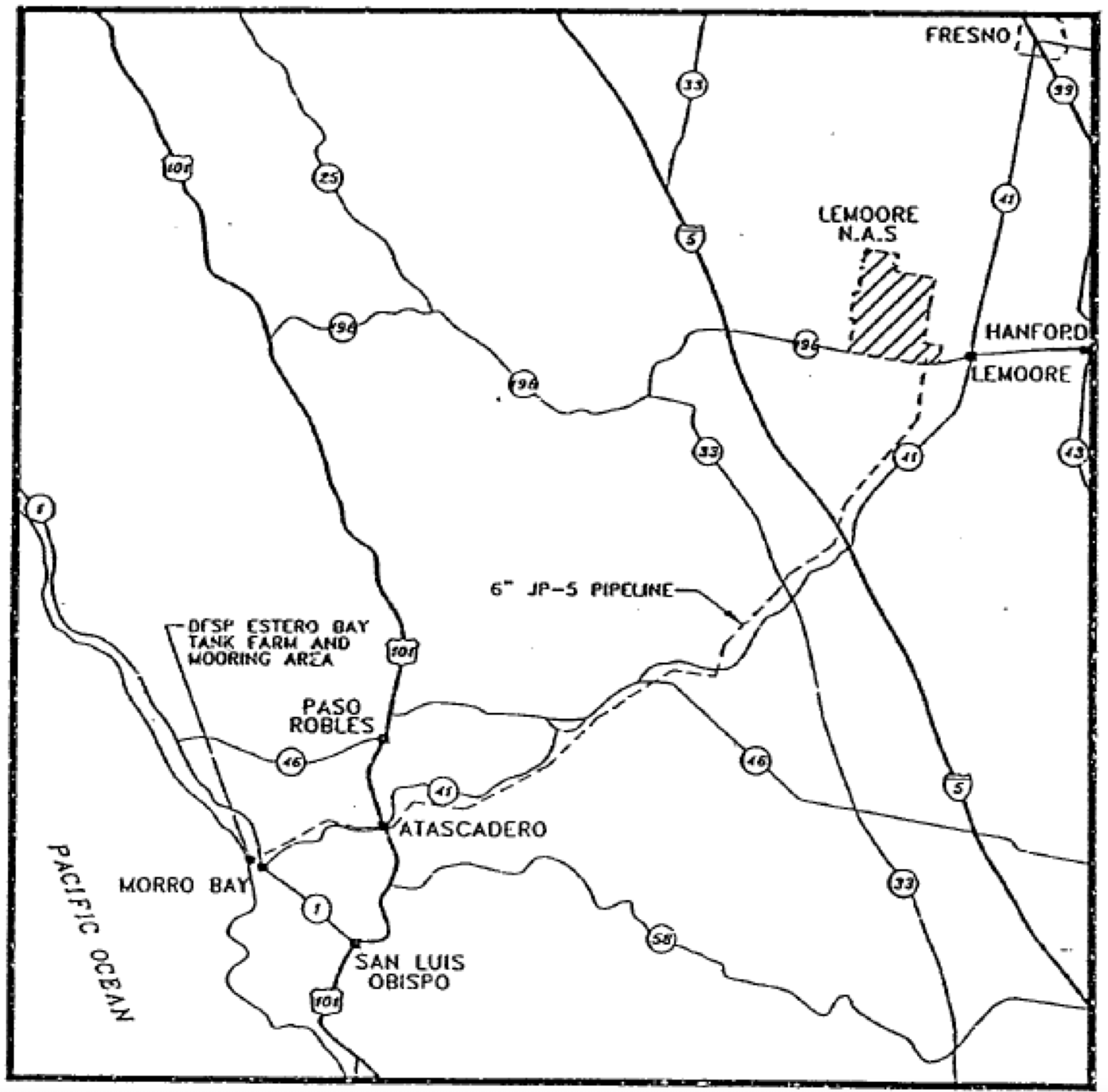
Intriguingly, there are existing pipeline opportunities in Central California from offshore oil rigs that connect to the shore that could carry water instead of oil if the deep sea OceanWell pods were in place nearby.There is also an old 50 mile pipeline that connects seaside Morro Bay to NAS Lemoore and the San Joaquin Valley that used to ship tanker oil to the Navy that is still in place. I know some thirsty Westside farms that would likely spring for that, as would the US Navy.