
-May 10.2023-
With a settlement agreement with the Sierra Club over a decade ago Tulare County has been implementing a plan to cut dairy emissions here in the biggest milk production county in the nation. The latest annual report published in late March details local dairy efforts in 2021 with financial help from CDFA.
It also evaluates the voluntary GHG emission reduction projects implemented at dairies and feedlots since 2013. The GHG inventory and evaluation of emission reductions were prepared pursuant to the 2019 Stipulated Settlement, entered into by the Sierra Club, Association of Irritated Residents, Center for Biological Diversity, and County of Tulare.
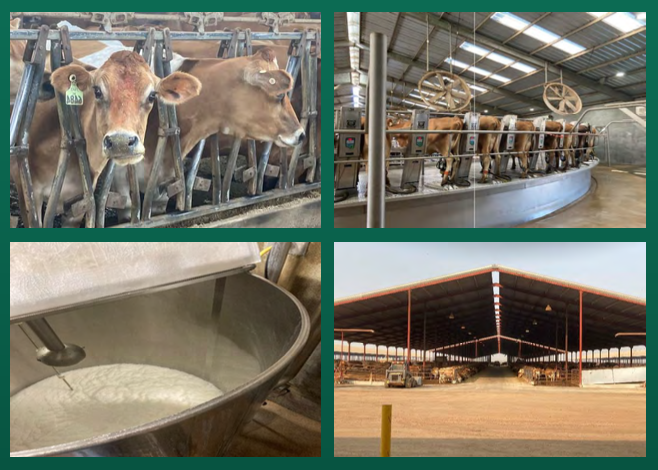 In 2021, the overall operation of County dairies and feedlots and their support crops produced an estimated 6,052,979 metric tons of carbon dioxide equivalent (CO2e) GHG emissions. This quantity was 19 percent less than the 2013 baseline year emissions and 3 percent less than the previous inventory year (2020) emissions.
The reduction in emissions from 2020 to 2021 was primarily associated with implementation of additional digester project. that capture methane emissions.
The voluntary emission reduction projects operating at County dairies and feedlots in 2021 included 70 solar panel projects, 11 solar thermal hot water systems, 38 digester projects, and 8 Alternative Manure Management Program (AMMP) projects. These projects provided 592,131 metric tons of CO2e reductions in calendar year 2021. These reductions constituted 56 percent of the annual emission reductions needed to achieve the Dairy and Feedlot Climate Action Plan (Dairy CAP) target by 2023. To meet the target, County dairies and feedlots will need to reduce emissions by an additional 457,869 metric tons per year by the end of 2023.
At the time of this study, the known additional projects scheduled for post-2021 start-up would provide further reductions of up to 418,796 metric tons of CO2e per year when operational. This leaves only 39,073 metric tons per year of emission reductions needed from yet-to-be identified solar, digester, AMMP, or enteric projects to reach the Dairy CAP target.
In 2021, manure management operations at County dairies and feedlots produced an estimated 4,902,137 metric tons of methane CO2e emissions. This emissions quantity was 15 percent below 2013 levels.
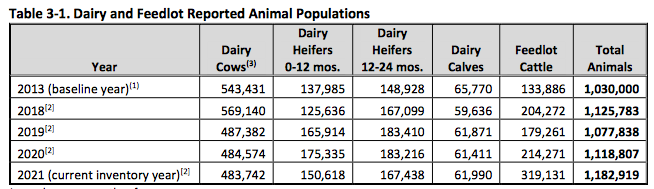
To meet the Senate Bill 1383 target, County dairies and feedlots will need to further reduce methane CO2e emissions by an additional 1,432,137 metric tons per year by 2030. At the time of this study, the known additional projects scheduled for post-2021 start-up would provide further methane CO2e reductions of up to 414,991 metric tons per year when operational. This leaves another 1,017,146 metric tons per year of methane CO2e reductions needed from yet-to-be identified digester, AMMP, or enteric projects by 2030. Changes to the animal population would also affect emissions.The latest figures show the total cattle population of the county is climbing.
More progress needed
 Although County dairies and feedlots have made significant progress in reducing their GHG emissions, additional reduction projects will be needed by 2023 and 2030 to meet the Dairy CAP and SB 1383 targets. The County will continue to track and regulate dairies and feedlots through its Animal Confinement Facilities Plan (ACFP) framework. Continued State and federal incentive funding will be necessary to make additional emission reduction projects economically feasible for the dairy industry.