
Could Help Provide Competitive Advantage
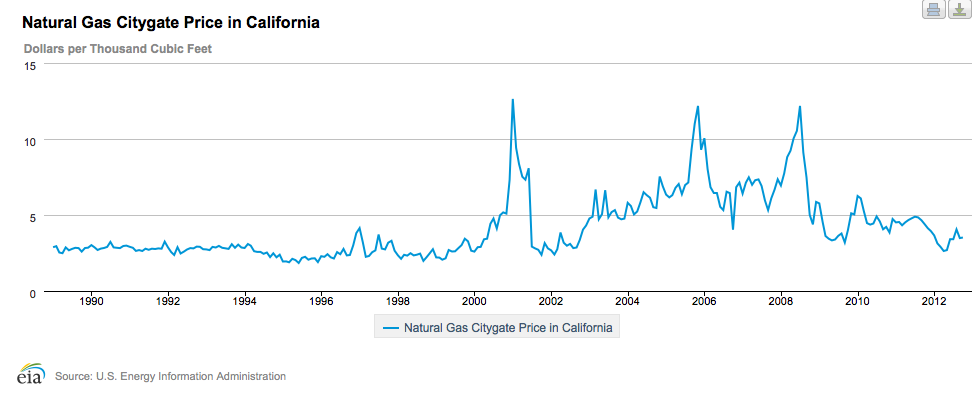
Average wholesale (spot) prices for natural gas fell significantly throughout the United States in 2012 compared to 2011 says the US Energy Information Service.The average wholesale price for natural gas at Henry Hub in Louisiana, a key benchmark location for pricing throughout the United States, fell from an average $4.02 per million British thermal units (MMBtu) in 2011 to $2.77 per MMBtu in 2012. That is isa 31% decline. This was the lowest average annual price at Henry Hub since 1999.
Natural gas meets 24 percent of U.S. energy demand, heats 51 percent of U.S. households and also cools many homes and provides fuel for cooking. It is also widely used to produce electricity, run huge broilers for industry and is a growing source for transportation fuel.
A mild 2011-12 winter, sustained high natural gas inventories, and rising natural gas production in the Marcellus and Eagle Ford basins contributed to lower average spot natural gas prices at Henry Hub. Average spot natural gas prices at Henry Hub fell despite rising natural gas use for power generation, lower overall natural gas net imports from Canada by pipeline, reduced liquefied natural gas imports, higher natural gas exports to Mexico, and temporary production shut-ins related to Hurricane Isaac. Total natural gas production was higher in 2012 than in 2011; however, in contrast to 2011, when production grew steadily over the course of the year, 2012 saw production generally remain flat, close to the level reached towards the end of 2011.
The decline in average wholesale natural gas prices was roughly uniform throughout the United States say the EIA.
The US will become a net exporter of natural gas expects the EIA. “U.S. natural gas production increases throughout the projection period outpacing domestic consumption by 2020 and spurring net exports of natural gas. Higher volumes of shale gas production are central to higher production volumes and an earlier transition to net exports than was projected earlier. U.S. exports of LNG from domestic sources rise to approximately 1.6 trillion cubic feet in 2027, double the 0.8 trillion cubic feet projected last year. The United States becomes a net exporter of LNG in 2016.”
One recent article points out that as a result of growing production here, coaxing natural gas from shale across the US puts the nation at an advantage compared to rest of the world and could even prompt more “in-sourcing” of companies returning to the US to manufacture.
“The United States’ #1 economic advantage against all other countries on Earth is its abundant natural gas reserves combined with its 1 million-plus mile natural gas pipeline distribution system. No other country has the combination of high natural gas production, low natural gas prices, and the ability to economically deliver natural gas to every major metropolitan city as well as to tens of millions of homes and businesses. It is an advantage the country cannot afford to squander.”
By contrast Chinese domestic natural gas production is very low, the country imports its natural gas by coastal terminals and needs to distribute it to the country’s interior.
California’s food processing plants rely heavily on natural gas to dehydrate and can fruits and vegetables.
As horizontal drilling and the controversial extraction technique known as fracking have made domestically produced natural gas more available and sharply cheaper, gas has been widely embraced by industry, electric utilities and trucking fleets.
A recent NY Times article point out the following.
The rapid development of shale gas technology has helped reduce energy imports and, in some cases, encouraged companies producing petrochemicals, steel, fertilizers and other products to return to the United States after relocating overseas. Natural gas exports are growing and terminals built to hold imported supplies are being repurposed for international sales.
The American petrochemical industry, for example, uses natural gas as both its primary raw material, in the form of liquid ethane, and as an energy fuel. And cheaper prices have led to a major expansion of capacity in the United States.
The hydrocarbon molecules in natural gas are split apart and then recombined as building blocks for many products, including bulk chemicals and fertilizers. The chemical ethylene, which is largely derived from natural gas, is used to make things like pool liners, building insulation and food packaging.
According to Kevin Swift, chief economist at the American Chemistry Council, European producers mostly use oil-derived raw materials for making these same products. “The U.S. has a competitive advantage when oil is seven times as expensive as natural gas, but now we have more like a 50-to-1 advantage,” he said. “The ‘shale gale’ is really driving this. A million B.T.U.’s of natural gas that might cost $11 in Europe and $14 in South Korea is $2.25 in the U.S. Partly because of that, chemical producers have plans to expand ethylene capacity in the U.S. by more than 25 percent between now and 2017.”