
-September 16,2021-
 In a strategic move away from the policies of the past, public transit agencies around the country are adopting unconventional plans to appeal to the next generation of riders. It involves a new model, a familiar private brand and it’s happening here too.
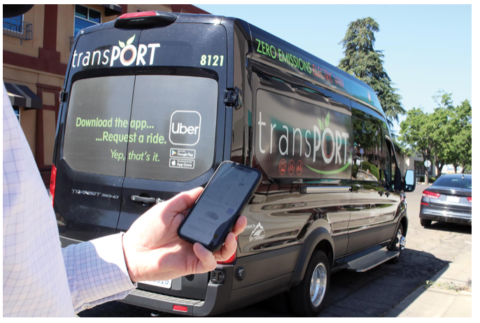
The new regional transit agency in Tulare County plans to partner with Uber to operate hundreds of zero emission transit vans around the county – allowing residents to use an app to get on-demand, curb-to-curb service.
The all-electric passenger vans will be used for transporting residents around the community, from home to work and for shopping and other services. The electric vans are designed to replace large transit buses on routes with low ridership.
Executive Director of the new Tulare County Regional Transit Agency Rich Tree says the program has already been pioneered in Porterville where a fleet of 12 modified Ford Transit vans outfitted with rechargeable battery powertrains are proving popular. Since May the vans, made in Colorado, have been branded with the Uber logo following an agreement to plug into Uber’s worldwide ride-hailing app – a marketing plus that has jump-started ridership. The service marks a new approach away from scheduled transit buses to door-to-door transit.
The vans seat seven passengers and include a wheelchair securement area.
Visalia too
The agency has submitted funding requests that have been positively received, says Tree, giving him confidence the countywide Uber ride share plan could be underway as soon as next year – including in Visalia.
“Although Visalia is not part of the 8-member agency, “we are in talks with the City to participate in the program as well.” Visalia alone could see a fleet of 100 vans itself running around town, he adds.
The TULARE COUNTY REGIONAL TRANSIT AGENCY (“TCRTA” or “Transit Agency”) is a joint powers agency formed by the County of Tulare and the Cities of Dinuba, Exeter, Farmersville, Lindsay, Porterville, Tulare, and Woodlake that became effective in August 2020.
The backdrop is this is a new approach to traditional transit in Tulare County whose transit ridership – like all across the US, has trended lower. In Tulare County a report says as of 2016 – 2017 county agencies saw a decrease in fare recovery ratio from over 20% to an average of less than 12% even though service hours increased 13% but riders decreased 14%.
The same report said the national decrease in bus transit passengers was even more dramatic in California. The portion of transit trips used for the daily journey to work is low, 0.7% compared to the national average (over 5%).
This is pre-Covid when transit users stayed away- abandoning big bus transit along with all mass transit – now in recovery with the economy.
With no place to go but up, Tree says the partnership with Uber – the best known brand among ride-hailing services – has proven to be a winner in Porterville with riders reporting they feel confident in using the Uber app, a well known commodity- to hail and pay for their ride. A trip is as little as $3.
Even if you don’t use the Uber app, the agency will be operating a dispatch service you can call on the phone.
Customers wanting a ride will use the Uber app to see the location of vans operating at that time, select the nearest driver and pay for the app just as you would when you order a ride from any Uber driver. Instead of a personal vehicle with an Uber sticker arriving, a van clearly marked and co-decaled as public transit will arrive and pick you up for the one-way trip. The van will pick up others en route to your destination.
Tree says the agency will set up a network of fast charging service stations for charging the vans-open to the public as well.”We are in talks with SCE and others to site the stations that will be operated by the agency.”The vans can be charged in just over an hour by a 50-kW DC fast charger. The stations will be an income source for the agency.
The Uber brand is helping to attract younger riders to the service, remarks Mr. Tree. Uber has worked worldwide to partner with cities to improve public transit.
Uber California-based
A company statement says “We share the same vision as the cities where we operate. All of us want cleaner, less-congested cities where everyone can move freely. In partnership with cities and transit agencies, we can help make public transit more accessible and easier to use while reducing private car ownership” says a company statement.
Uber argues that they can make access to transit available to everyone, including those with accessibility needs.
Uber points to some 50 successful government partnerships using tried-and-tested solutions and customized products to meet community needs.
Uber Technologies, Inc., commonly known as Uber, is an American technology company. Its services include ride-hailing, food delivery (Uber Eats), package delivery, couriers, freight transportation, and, through a partnership with Lime, electric bicycle and motorized scooter rental. The company is based in San Francisco and has operations in over 900 metropolitan areas worldwide. It is one of the largest firms in the so-called gig economy.
Uber is estimated to have over 93 million monthly active users worldwide. In the United States, Uber has a 71% market share for ride-sharing[and a 22% market share for food delivery.