
-July 29,2021-
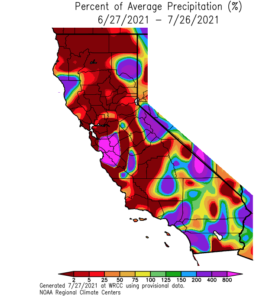 Monsoon surprise
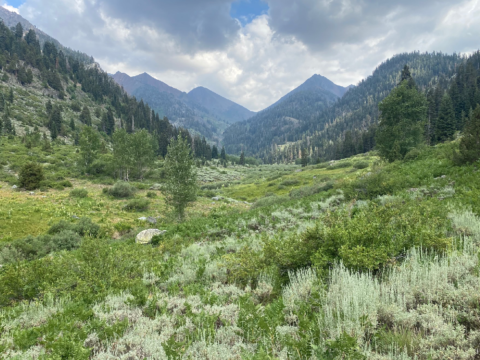
This year’s monsoon weather pattern is bringing wet weather to the eastern Sierra in July. Estimates that this years monsoon may be the wettest in memory – not just in the Southwest- but in all portions of California creating this poka-dot pattern on our map. Daily thunderstorms are expected in the eastern Sierra every day into next week.Death Valley got a dosing.The totals were not great, but LA has seen the wettest July on record. The spiraling moisture is even bringing thunderstorms to the Bay Area – over an inch in July) and this week up into Canada.Wet weather in the high Sierra is helping to green-up Mineral King Valley this summer.( Mineral King Valley in mid-July ,2021)
AR in January brought half this year’s Sierra snowpack
A single atmospheric river (AR) event in January 2021 provided about half of the snowpack for the year in the Friant service area above Fresno, says the water agency. The upper San Joaquin River is the source of the all important Friant Kern Canal. While we are concerned over the overall precip trends over the winter months, just a few storms, largely unpredictable, seem to make the difference in our water supply. Might as well roll the dice to predict Sierra runoff.
Sequoias lost in 2020 fire
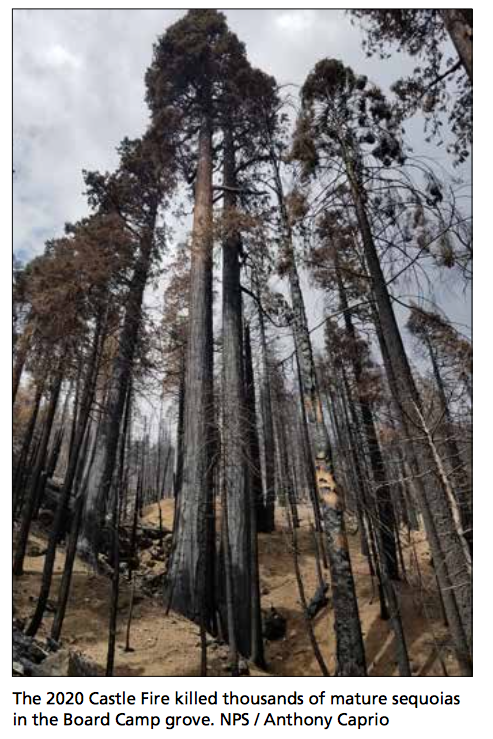
The National Park Services estimates of sequoia mortality in the 2020 Castle Fire are in. Although some giant sequoia trees have stood for thousands of years and are adapted to withstand frequent low and mixed severity fires, preliminary estimates suggest that the 2020 Castle Fire killed between 31 to 42% of large sequoias within the Castle Fire footprint, or 10 to 14% of all large sequoias across the tree’s natural range in the Sierra Nevada. This translates to an estimated loss of 7,500 to 10,600 large sequoias.
The 2020 Castle Fire (also known as the SQF Complex) started from a lightning strike on August 19 in Sequoia National Forest and later burned into the southern portion of Sequoia National Park.
The hotter drought of 2012-2016 was a tipping point for giant sequoias and other Sierra Nevada mixed-conifer forests. The result is higher severity wildfires resulting in the death of thousands of large giant sequoias, bark beetles as a newly observed cause of death, and acute foliage dieback as a short-term response to drought.