
Hanford & Porterville await the promise
With great promise, two electric vehicle makers have said they would build factories in the Central Valley and soon employ hundreds, even thousands of locals. Both announcements came in 2017. Four years later, the promises are still coming but so far, only a handful of jobs have resulted.
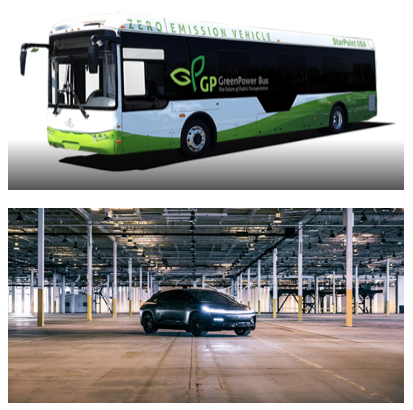 Now electric vehicle stocks are rallying, bolstered by President Joe Biden’s plans to back massive investments in the EV market.In recent months our two EV companies have been raising millions from investors and jobs, it is said, are on the way. Hope or hype, that is the question?
In the case of one company – Faraday Future we have heard this before. In August 2017, the company announced that it had signed a lease for a former Pirelli tire plant in Hanford, California. The company said that it could employ up to 1,300 people over time and build up to 10,000 cars a year at that location.Today, there are a handful of workers at the sprawling million square foot facility. Yet Faraday Future’s new merger promises to raise $1 billion & make electric cars in Hanford with production slated to begin by the end of 2021.
The company’s namesake, British scientist Michael Faraday, is known for the discovery of electromagnetic fields – the basis for modern electric motors.
Faraday Future is said to be investing $90 million to remodel the Hanford plant (they lease it) and announced they already raised $100 million toward their goal of a billion dollar war chest after the merger is complete. That is expected by the end of June.
Yet the company has so far taken out no building permits at the plant in the Hanford Industrial Park with the exception of a fire pump permit a few weeks ago says the city’s chief building official Tom Webb.”We hope they will” make a major investment, he says.
As for hiring, right now Faraday Future(FF) on their website does list 60 jobs ready to fill at its Gardena (LA) facility – but just 4 in Hanford.
The company announced in late January that it is merging with a special purpose acquisition company called Property Solutions Acquisition Corp.(PSAC) and will be listed on the Nasdaq Stock Market once the transaction is complete sometime in the second quarter of this year.
The company early this year announced the following.
“The new round of debt financing will be used to fund operations and accelerate the FF 91 program even further, including the start-up of manufacturing at FF’s production facility in Hanford, California.”The preparation and start-up of the Hanford manufacturing facility will include new hiring, additional construction, and equipment installation and calibration to ensure the on-time production and delivery of FF 91.”
At their January announcement, management said on a call with reporters ”We are pursuing a hybrid manufacturing strategy that balances quality control considerations with cost and scalability. We operate our own plant in Hanford, California, which will have an initial capacity of ten thousand units, and needs an investment of less than $90 million to begin production. This allows us to control the production process and really understand quality control considerations. In addition, to deliver the volumes in our business plan, we have secured contract manufacturing capacity with a partner in South Korea for volumes of up to 270,000 units.”
The first futuristic version car FF 91 will be for the wealthy only – slated to be launched within 12 months after funding, and positioned to compete with Maybach, Bentley, Lamborghini and Ferrari.
Hanford almost ready to go?
“The most important thing we want to highlight is that FF has completed the majority of the work needed to launch the FF 91. We have concluded the prototype phase and the preproduction validation. Production tooling is 91% complete and 75% of the equipment in our production facility is onsite and ready in Hanford. FF’s next step will be to initiate the production tryout process, followed by launch of production….”
PSAC stock rose to $19 a share in February but has declined to just over $12 today.
It is a similar story in nearby Porterville.
Porterville- City orders buses from GreenPower rival company
In 2016, Canadian start-up GreenPower Motors announced they would make Porterville its US manufacturing base for a line of electric buses and transit vehicles.
Porterville itself was excited to buy ten 40-ft electric buses for their transit system buoyed by state vouchers to pay for them plus adding a new home-town manufacturer.
This was big news around Porterville with a local TV station announcing After months of being under-wraps, an electric-powered bus business venture is coming to Porterville.
Nearly 10 acres of empty, dry land will soon be taken over by something very green.
Canada-based GreenPower Motor Company plans to build a 150,000 square foot assembly facility here for their electric-powered vehicles.
“There are billions of dollars that are looking to be programmed over the next several years into low-carbon emission vehicles, electric vehicles,” city manager John Lollis said.
A 2016 editorial in the local paper welcomed the company to Porterville and laid out a rosy scenario.
“City officials said the company will employ as many as 60 workers at the start, but could grow to more than 1,000 employees. The jobs are factory jobs with good pay and benefits.
City manager “Lollis said the company plans to grow in phases with more than $10 million being invested locally over the next two years.
GreenPower offers seven different buses, ranging in length from 35- to 45-feet. They hold anywhere from 25 to 100 passengers and have a range of 175 to 240 hours. All can come with air conditioning.
The company delivers buses all over the world.”
In a federal Securities and Exchange filing, GreenPower repeated the promised plan.
“During the year ended March 31, 2017, we purchased 9.3 acres on Hope Drive in Porterville California which is being financed with a promissory note. We completed the plans for the civil work, obtained a grading permit and have submitted plans for the construction of a 144,000-square-foot manufacturing facility. The facility will be built in three phases with the first phase consisting of 50,000 square feet to come online next year.”
Still waiting
But here we are 4 years later and the permit is “still waiting to be picked up” says Porterville city Transit Manager Richard Tree.
Tree says, like most locals, is anxious for the bus maker to move forward on what they had announced.
Tree adds that in the past months ”They told us that their manufacturing plant is dependent on the fund raising from their going public on the Nasdaq last summer- taking advantage of investor interest in electric-powered vehicles like Tesla.”
Last August, the company issued stock that has gone from $8 a share, climbing to $34 and now around $18 – falling slowly this calendar year.
Tree adds that other issues are troublesome.That includes GreenPower’s refusal to carry out accepted crash tests on their large buses – a requirement for federal funds that transit agencies use to buy the vehicles.”They told me that they want to concentrate on smaller transit vehicles” he explains.
In addition, questions have arisen about whether GreenPower vehicles are “Buy America compliant”, again a requirement for federal funds.Tree notes that GreenPower gets their buses and smaller transit vans from a manufacturer in China and they are only modified here in the US.
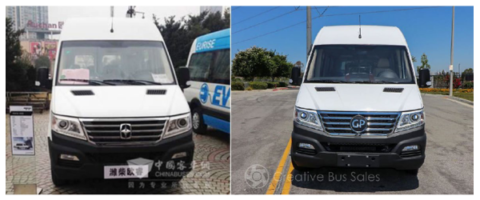 One critical Wall Street report done by White Diamond Research charges that ” All they do is sometimes install seats and wheelchair ramps in the buses. The source asked the warehouse manager where they integrate the parts, and he responded “oh, that’s all done in China”. We have pictures that the source took in the warehouse, as well as side by side images of GreenPower’s bus and the Chinese company bus, they are exactly the same except for the GreenPower logo.
Transit manager Richard Tree says he has read these reports and believes they are essentially true.
“Are they a US manufacturer of electric vehicles – probably not” he suggests.
Tree, like most here, are still pulling for GreenPower to come through.”We would like to see them do a manufacturing plant here sooner than later” he says
All these questions have resulted in fewer GreenPower sales- in Porterville, their home base, and all over Kings and Tulare Counties for that matter.
A few weeks ago the Porterville City Council approved the purchase of three new electric buses from a rival of GreenPower – New Flyer – a US company with three American manufacturing plants
Pushing agencies into buying American-made components is President Biden’s stricter Buy America rules requiring buses have 75% US-made parts.
Tree says “Tulare County transit agencies need to upgrade their fleet and are scheduling purchase of up to 100 electric buses. “ We would love to buy them from a local manufacturer.” A new Regional Transit agency is being formed in Tulare County who’ll buy all the clean vehicles for all the cities except for Visalia. But they must meet the crash test and Buy America rules that GreenPower may not qualify for.
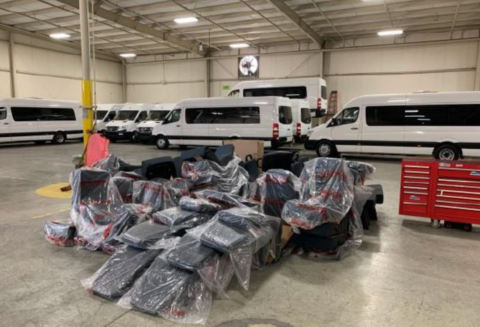
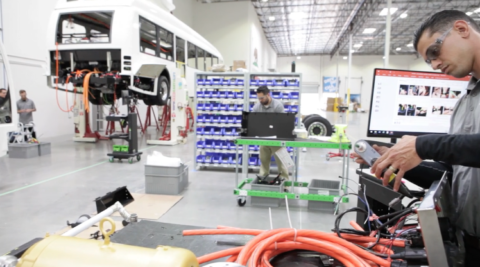
Not only did Porterville recently choose to buy 3 rival firm’s electric buses recently, Visalia, who already has Proterra-made buses, is about to buy 4 more 35 ft buses as well from Proterra. The company’s factory in Los Angeles is state of the art and full of machinery. It contrasts with Porterville’s GreenPower’s leased warehouse, largely empty of machinery. Like in Hanford, only a handful of jobs are based in Porterville. Here are pictures of both facilit
Other transit operators also need some convincing.
Kings County transit agency led by Angie Dow says they plan to replace their fleet in the next few years, The California Air Resource Board has mandated all transit agencies transition from gas, diesel, and CNG Buses to Electric Buses.Dow says the agency will convert its fleet of 36 vehicles to all-electric. Asked if the agency would consider Valley-produced GreenPower buses for purchase,Dow quickly replied “Oh no – they are not Buy-America Compliant”.
Compared to Tesla?
If there are critics of GreenPower, there are also plenty of boosters. Here is a recent article suggesting investors purchase stock of GreenPower (GP)
“Canadian-based GreenPower with its assembling plant right here in Porterville is set to become the “Tesla of Buses,” according to an article recently posted on NASDAQ.com and InvestorPlace.
The article stated the company, worth less than $200 million now, has the potential to be worth as much as $10 billion in the future.
GreenPower listed on the NASDAQ in 2019 and has continued to grow in value since its listing. The NASDAQ is a listing for electronic trading that includes mostly technology and up and coming companies. GreenPower can definitely be referred to as an up and coming company.
Since its listing, $38 million in capital has been generated that could possibly be used to expand the Porterville facilities’ expansion capability. The Porterville facilities design, build and distribute battery-electric full-size buses, school buses and shuttle buses. There’s also a nine-acre piece of property in Porterville that can be used for expansion.”
The most recent financial report in February showed the firm had revenue of $2.40 million for the quarter, compared to analysts’ expectations of $4.36 million.
A glance at their website shows in the past few days they have posted a job request listed as Production Team Member.
Calls to GreenPower CEO Fraser Atkinson were not returned.