
-June 2,2020-
Subsidence along the Tule area FKC has cut capacity by 60 percent
Talks focus on mitigation plan – what about impacted wells in Pixley & Teviston?
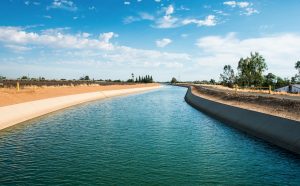 Without the construction of the 152-mile Friant Kern Canal (FKC) in 1951 at the cost of $61 million, many of the best producing ag areas along the east side of the San Joaquin Valley would be out of business. The reason is simple – by the late 40s farmers had pumped themselves dry. Productive citrus growing areas like Orange Cove, Lindsay and Terra Bella for example- have little groundwater available.
The FKC serves farms and communities from Chowchilla in the north to Arvin Edison near the Grapevine in the south. Its waters boost the area’s economy to the tune of millions of dollars.
As the Valley moves forward on sustainable groundwater monitoring plans and proposed pumping restrictions by district, the gravity-fed canal that is key to east side farms survival continues to be impacted by subsidence. Land around the Tule subbasin near Porterville appears to be most worrisome where the land has sunk so much due to adjacent water pumping that the Friant Kern Canal has lost 60% of its capacity to move water south. As of July 2018, it is estimated that the FKC is approximately 12 feet below the original constructed elevation.
It is not supposed to be like this. In an effort to avoid further damage to key infrastructure – the state mandates that local groundwater districts offer their plan of how they will manage their groundwater. In January, water users in 21 severely overdraft basins in California submitted their sustainability plans to the state under SGMA- the Sustainable Groundwater Management Act.Under the law, local districts called GSAs-Groundwater Sustainability Agencies – must avoid “significant and unreasonable”impacts – arguably like next to a multi-million dollar waterway.
Now the Friant contractors and number of other affected groups worry that some groundwater plans are not being aggressive enough to halt subsidence to zero.But that is the goal of the sustainability effort, particularly near infrastructure. Under SGMA, critically over-drafted basins should reach sustainability by 2040.
Canal capacity could drop to 30%
In December the regional office of the Bureau of Reclamation commented on 8 Tule area GSAs plans to allow more subsidence over the next 5 years- despite the fact the Friant Kern had already dropped 12 feet since it went into service.The Bureau predicted the proposed 5 year interim plan may result in the land along the canal dropping another 3 feet, reducing capacity of the canal to just 30% of its original design.That’s 10% worse off than now.The pumping would come from farms on surrounding lands within the GSAs not served by the canal.
These are the so-called “white areas” in the Valley where groundwater is the only source to irrigate – lands typically not a part of an irrigation district. That is thousands of acres of land in the Tule subbing -land that if they want to keep producing – must join a GSA.
The PPIC – Public Policy Institute of California has estimated “nearly 20%—or 840,000 acres—of irrigated cropland in the valley has no access to surface water. Crops are similar in groundwater-only lands and lands that have at least some access to surface water: more than half are planted with permanent fruit and nut crops. These crops provide higher revenues and employment than most annual crops. With groundwater cuts looming and no other water supply to fall back on, groundwater-only areas are on the front line of the effort to bring basins into balance.”
The SGMA goal is to bring all irrigated lands into a program that make it possible to lessen the costs of implementing sustainable groundwater management, a transition that will benefit the valley over the long run, suggest advocates.
Inspiration and irony
It seems ironic that the canal is being affected this way says the Bureau noting that “the very existence and inspiration of the canal was to..combat such issues as subsidence by conveying surface water to incentivize farmers to pump less groundwater.”
The Bureau’s worries reflect a number of other water districts fears up and down the east side that increased subsidence in the Tule area will affect their own ability to reach sustainability since they cant get their full contract supply of FKC water. All GSAs need to come up with final sustainability plan by 2025.
The worst subsidence is along the so-called The Middle Reach of the FKC, an approximately 33-mile section located within Tulare and Kern Counties that has experienced significant capacity loss.One neighbor district, Lindsay Strathmore ID summed the problem up short and sweet. “Allowing for three additional feet of subsidence along the Friant-Kern Canal is unacceptable without adequate mitigation. ”
Among the other ironies is the fact farmers are demanding the feds bring more more water from out of the area but some of the same farmers can’t use the water they are already allocated or maintain the infrastructure that brings in that water.Over pumping may be both sinking the land and sinking farmers’ future.
Another twist – farmers did not like this state sponsored groundwater restriction idea but the implementation of the plan on a local level may yet save this canal that feeds them.
$500 million price tag
Working feverishly to restore the capacity to deliver water to their 15,000 family farms, Friant Water Authority is busy lobbying on the federal and state level to raise as much of the anticipated repair costs of $500 million from public monies to restore the capacity they have lost.
The project missed a chance in 2018 when a state publicly funded bond initiative failed. One newspaper editorial weighed in- perhaps unfairly. “The bond substantially benefits billionaire stakeholders and is a bad water deal for Californians.”
Now the federal government may be the only game in town suggests Dan Vink who heads up the South Valley Water Assn – not involved directly in this controversy. ”With COVID, the state is looking to cut budgets and may not be able to come up with new money for this project” suggests Vink. Project proponents had counted on at least some state funds.Last year state Senate Bill 559 looked promising to spend $400 million on the canal. But that was before COVID-19 hit the fan and the state budget.
Meanwhile there is an on-going effort to include this project in bills with federal stimulus money. This would still require a local match for whatever sum they can get. “Right now the federal government is spending money like a drunkin’ sailor” Vink observes.
But the drama here is at the local level as Friant and the Tule subbasin agencies are “in negotiation” says Friant CEO Jason Philips and “making good progress” on coming up with an agreed sum as mitigation for the extra “damage” the subsidence will mean to the project design- ie higher costs.
Friant has already announced plan to buy more land to build a parallel canal along 20 miles of the 33 mile affected area.They vow to have a plan in place by December 2020. So time is short.
cooperation or litigation?
Vink says she understands Friant has proposed a damage figure of $200 million-some estimate it is $263 million- they are looking to have Tule farmers come up with. That could add up to a local match! Vink adds he is not sure if the talks will lead to ”cooperation or litigation.”
Calls to several of the Tule water districts general managers were not returned.
Friant has proposed a damage figure of $200 million-some estimate it is $263 million- they are looking to have Tule farmers come up with.
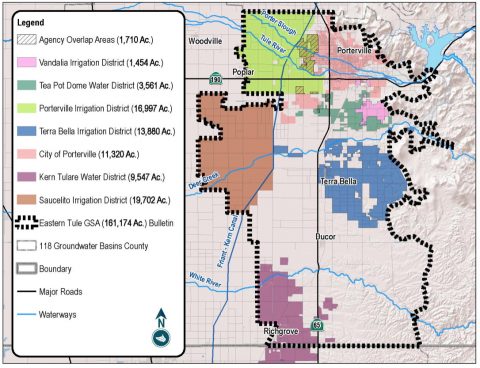 Pictured:one GSA with white areas
But Delano-Earlimart General Manager Eric Quinley says his own district- while part of the Tule Subbasin – “is in a sustainable position” unlike some neighbors to the south. His district includes thousands of acres of white area not served by an irrigation district before but includes farms that are now part of his GSA and “willing to pay the cost to stay in business.” Many of these the white areas have permanent plantings with good revenue streams that can afford to contribute to fixing the canal .
Quinley believes any district that does not offer a sustainable plan will hear from the Dept of Water Resources who continues to take comments on submitted sustainability plans.”They have not approved the plans yet.”
A letter from Friant’s Phillips says subsidence in the Tule Subbasin has already caused “significant inability to convey water during wet years such as 2017 and 2019 where FWA estimates that upwards of 300,000 AF could have been delivered to Friant Districts but for the capacity restrictions caused by subsidence due to overdraft groundwater pumping in the Tule Subbasin.” A major goal of the system is to convey flood waters during wet periods, water that can replenish groundwater in this overdraft basin.
With continued subsidence in the Tule Subbasin, the Friant districts’ deliveries will be reduced and therefore northern FKC contractors’ prorata share of the FKC O&M will also increase Friant argues. All are affected -not just the Kern basin farmers they suggest.
Subsidence due to groundwater pumping has been occurring in the San Joaquin Valley for almost a century, but it accelerated during the 2012–16 drought.There is a famous photo of how much land on the westside has sunk.
The big westside canal – the California Aqueduct has lost a 20% of its capacity from subsidence as well.The state is paying that cost but the GSAs there may have to end up paying as well. Looking at proposed plans by westside GSAs the Department of Water Resources found that an additional 2.1 feet of subsidence in some sections of the California Aqueduct could further harm downstream water users. This is roughly one-third of the maximum amount allowed in the vicinity of the aqueduct by the Westside basin plan (6 feet).
Its not just farms that are impacted by sinking land. Roads, highways, bridges, freight rail and even high speed rail are facing higher costs to engineer, maintain and build infrastructure. Total damage could reach in the billions Valley-wide by some estimates. Also as pumping causes groundwater levels to drop, basins can draw in water from adjacent rivers and streams, reducing river flows and harming habitat notes PPIC.
Water wells affected?
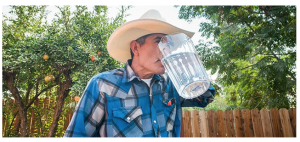 Visalia-based advocate group Community Water Center also commented in December that the Tule GSAs plans will likely affect low income residents and other water users that the live in the Tule region.They estimate that “the usability of over 73% of domestic wells near the representative monitoring wells in the Pixley GSA area would be expected to be significantly impacted if water levels reach the proposed minimum threshold proposed by the GSA.Water levels could fall an average of 70 feet near Pixley and Teviston along Hwy 99 they argue.They suggest a A Drinking Water Well Mitigation Program could include a combination of different strategies including: replacing impacted wells with new, deeper wells, connecting domestic well users to a nearby public water system, or providing interim bottled water.
PPIC says it is not only Tulare County water wells that may be affected. In “the Kings Basin—home to a dense network of well-dependent communities—where three plans acknowledge that roughly 600 domestic wells may go dry, but do not consider this a significant and unreasonable impact of continued overdraft.”
Also the Audubon Society fears the impact of over-pumping on the 900 acre Pixley Wildlife Preserve.