
-May 4,2020-
South Coast’s Rincon Island will lose its oil wells
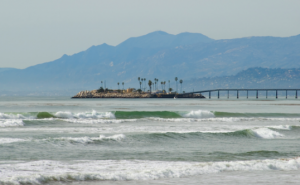
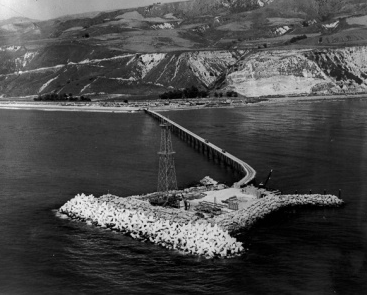 A symbol of the time that oil wells covered large swaths of southern California, Rincon Island – off the south coast near Ventura- is about to lose more of its oil wells.The job should be complete by June 2021.
The state Lands Commission says they have abandoned about 60 percent of the Rincon wells. The state ended up directing the work after the owners‘ lender- UBS AG Bank granted the Commission a quitclaim in December 2017 meaning the last operational offshore oil drilling and production facility in the Santa Barbara Channel is over.
The nonprofit California’s Coastal Sanctuary will inherit it.
The latest work involves the permanent plugging and abandonment of all 75 oil and gas wells located both offshore on Rincon Island and the onshore facility (50 offshore and 25 onshore). The man-made island – some 2.3 acres was built in 1957-1958 and is 3,000 feet offshore in 55 feet of water. It is connected to the mainland by a one-lane wooden vehicular causeway known as the Richfield Pier, which contains the gas and oil pipelines. The offshore leasing of the Rincon Oil Field began from 1929 to 1931 with the issuance of leases for the lands and ended in 1955 with the issuance of a new state lease. Several different oil companies have held these leases over the years. By the end of the 1980s, Atlantic Richfield Company (ARCO) and Berry Petroleum Company held all the various state leasehold interests at Rincon.British Petroleum (BP), which acquired ARCO, now has this liability.
Solar project moving forward in Fresno County
Longroad Energy, a U.S.-based renewable energy developer, owner and operator, has reached financial close and started the construction of Little Bear Solar – comprising four separate projects totaling 215 MW DC – in Fresno County.
PUC upgrades emission goal – more storage in works
The state’s Public Utilities Commission set a target of reducing greenhouse gas emissions to 46 million metric tons by 2030, 56% below 1990 levels. The goal outpaces the state’s overall goal of slashing emissions to 40% below 1990 levels by 2030.
California electricity providers will need to develop nearly 25 gigawatts of renewable energy and battery storage to achieve the goal, nearly double the amount the state has currently, CPUC Commissioner Liane Randolph said in a statement. The agency anticipates 8,900 MW of energy storage will be included in that total, or about eight times more than existed in the entire United States at the end of 2018
Vistra will expand Oakland battery storage
Texas-based Vistra, who owns the mothballed power plant in Morro Bay, has announced that it is increasing the size of its battery energy storage project located at the site of its Oakland Power Plant. The battery will now have a capacity of 36.25 megawatts/145 megawatt-hours instead of the previously announced capacity of 20 MW/80 MWh. Vistra anticipates the battery storage project will enter commercial operations by January 2022. The project has received necessary approvals from East Bay Community Energy (EBCE), a Community Choice Energy provider, and from Pacific Gas and Electric (PG&E).
Kings biogas project moves forward
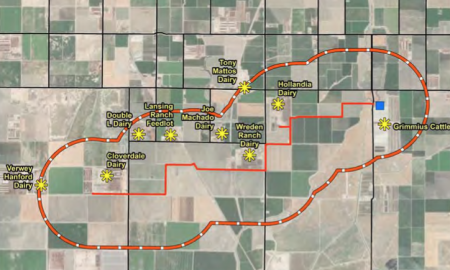
The Hanford Biogas Cluster Project will get a hearing this week at the Kings County Planning Commission. With some incentive funding forth state the project would involve the construction, installation and operation of a 7.3-mile pipeline and a biogas upgrading facility. The primary purpose of the project is to transport raw biogas from nearby dairy facilities and upgrade that gas to natural gas standards.The biogas facility will connect Cloverdale Dairy, Wreden Ranch Dairy, and Hollandia Dairy, there are nine other bovine facilities located within the project vicinity.Biogas from the dairies will be cleaned up to use as a transportation fuel.