
-October 29,2019-
Murray Energy Files for Bankruptcy, Casualty of Coal’s Decline
Wall St Journal
Robert Murray, the last U.S. coal baron, couldn’t convince the Trump administration to bail out the industry
Murray Energy Corp., the coal producer led by outspoken Trump administration ally Robert Murray, has filed for chapter 11 protection, a stark example of coal’s diminished role in the U.S. energy sector. The company was the largest coal producer in the US. Alliance Resource Partners now the only top-5 coal company in US not to file for Chapter 11 bankruptcy reorganization recently.
Micro power grids emerge as way to keep electricity on during shutoffs
KQED
For two days, life in Northern and Central California was completely upended by PG&E’s power shutdowns, affecting hundreds of thousands of customers. The outages renewed questions about why the utility did not include resilient grid technology, such as the microgrids employed at three Fremont fire stations, outfitted with a sophisticated power system designed to keep running when the grid goes down. Fremont is one of the first cities in the U.S. to install a microgrid, a small, self-contained electrical system, around a fire station. Fremont’s microgrid includes solar panels, batteries, and a generator. Control software allows the stations to operate independently from PG&E’s grid. The California Public Utility Commission is examining how projects like the one in Fremont can help shore up the system and make power shutoffs less disruptive.
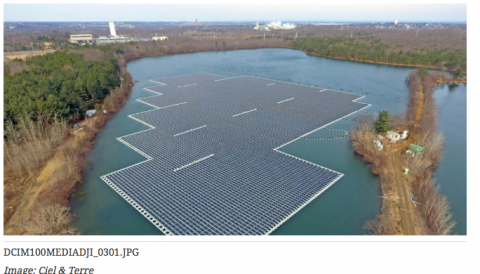 Floating solar project completed: New Jersey
EVs could shift all residential peak load
Microgrid Knowledge
Functioning as a virtual power plant (VPP), it would take just 10% electric vehicle (EV) market penetration in Southern California Edison’s (SCE) service territory, 5,000 customers, to shift residential peak power load to evening hours, according to an independent, self-funded study from Jackson Associates.
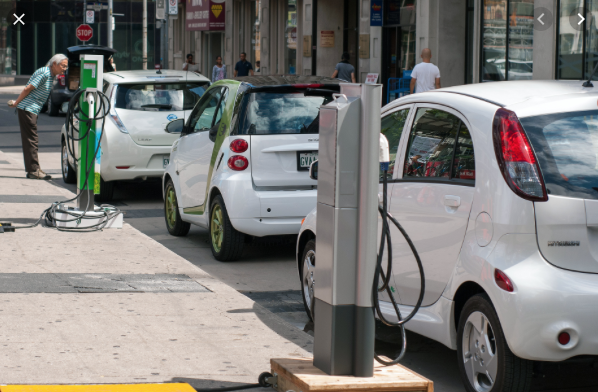 “We were surprised both at the relatively small 10% EV market saturation required to completely clip the SCE residential peak and the large annual savings of $560/EV per customer even after paying for nighttime recharging,” said white paper author and company president Jerry Jackson. “These results suggest that utilities should shift from defensive, managed charging strategies to an offense strategy that draws on electric vehicle battery storage during peak hours with overnight recharging.”
The EV battery power “offsets the increase in electricity use of other customers that typically occurs in these four hours, thus clipping the peak from the utility’s perspective,” Jackson said in an interview.
Jackson Associates chose SCE because the analysts wanted an area that had a reasonably high level of summer air conditioning load and would benefit from an VPP based on peak and off-peak electric price differentials, Jackson explained.
“Reducing EV customer electricity use to zero in each of the four peak hours by drawing on EV battery power offsets the increase in electricity use of other customers that typically occurs in these four hours — thus clipping the peak from the utility’s perspective” he told Microgrid Knowledge.
Jackson calculated an average utility cost savings to consumers of $560/year by doing so, and a net cost savings of of $400/year when the customers’ costs of additional charging cycles was added in. “There will be some utility costs to provide the infrastructure and run the program; however, most of the costs savings should flow through to customers, Jackson commented.