
-August 15,2019-
Turning rigs into reefs
25MW pilot project may get Department of Defense green light
Prospects for California floating offshore wind projects have been stalled for several years largely because the US Navy has yet to find any place off the West Coast that does not pose a conflict with their seagoing operations.
Guarding the gate for the Navy is Steve Chung, Encroachment Program Director for the Navy, based in San Diego who offered a few days ago that despite the delay “discussion is underway at the highest level of the Department of Defense (DOD) leadership to see if something is possible.”
At least 11 international companies have lined up ready to bid on a potential lease if offered by the federal government.
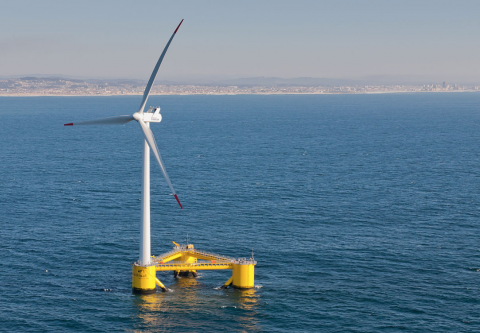
A second federal agency, the Bureau of Ocean Energy Management (BOEM) has announced they would like to offer leases offshore potentially in three areas including in federal waters (3 miles out) offshore of Diablo Canyon, Morro Bay/Cambria and off Humboldt in Northern California. But like the rest of us, they are waiting for word from Steve Chung.
Now there is a surprise development.
A French company Ideol has applied for a permit to do some wind speed testing in state waters – less than 3 miles out – off the Vandenberg Air Force base coast.That area on the Santa Barbara coast is not on the current BOEM list, at least not yet. Jurisdiction for state waters falls to the California State Lands Commission who will hear the new request at their August 23 meeting in LA.
Endorsing the pilot idea is Vandenberg AFB who is looking to diversify its power sources including more marine renewables. Already the base gets about 35% of their electricity from their new 22MW solar plant on the base, built by SunPower and in operation for about a year now.
“Vandenberg Air Force Base is supportive of the Ideol offshore wind energy project as an option to consider in its efforts to increase its overall energy resiliency. These types of projects are assessed to ensure they have no adverse mission impacts and are also subject to U.S Air Force and U.S. Department of Defense considerations and approvals,” said Col. Michael Hunsberger, 30th Mission Support commander.
“Vandenberg Air Force Base is supportive of the Ideol offshore wind energy project as an option to consider in its efforts to increase its overall energy resiliency. These types of projects are assessed to ensure they have no adverse mission impacts and are also subject to U.S Air Force and U.S. Department of Defense considerations and approvals,” said Col. Michael Hunsberger, 30th Mission Support commander.
Ideol is not the only company who has expressed interest in supplying offshore wind power to Vandenberg. Well aware of the new initiative is Steve Chung who says his office has received interest from several other companies.“in both wind and wave power” at the Vandenberg location.
Chung, after all represents all branches of the military as a DOD official and will be involved because of the likelihood energy operations could extend into federal waters as well as state waters.
“I will be there at the Lands Commission meeting“ and will likely be part of the discussion, he says.
Ideol on their website says they have installed a 2 MW floating wind turbine off the Atlantic Coast of France.The company has yet to respond for comment regards Vandenberg. During the first half of 2019 France’s first offshore wind turbine produced a total of 2.2 GWh and faced significant wave heights up to 38 feet, they reported.
But 2MW is actually small compared to the state of the art right now with GE selling a 12 MW offshore wind turbine with blades that reach past 2 football fields. It is not likely to stop there as the Dept of Defense is reportedly working on a 50MW turbine with hinged blades so the units can be shipped on a truck.
The idea is that a few wind turbines off the Vandenberg coast could potentially supply the base with some 25MW of power that could double their renewable power and help make the base more “resilient” to potential energy disruptions- a major concern for military bases.
The plan to do a project off the Vandenberg coast is apparently no secret although the best of our knowledge, this is the first news report.The well-connected Surfrider organization recently posted a white paper on offshore renewables and stated the following without citing a source.
“Vandenberg Pilot Project is a proposed 3-turbine floating offshore wind farm off the Vandenberg Air Force Base in Santa Barbara County, California. Working with multiple universities, this pilot project hopes to establish a “marine energy research area” off the coast, and then develop within those spatial limits.This wind energy project is also proposing to use the transmission cables currently used by an active oil rig, thus reducing the additional cost and environmental impact of laying new subsurface cables and onshore connections.”
Confirming the scenario, the Navy’s Steve Chung says to the degree a project would utilize existing infrastructure already in place – it would ease the navy’s concerns. “It would be less impactful if a renewable project utilized the cable that connects to the shore from Platform Irene” he says – some 5 miles off the Vandenberg coast. This is a oil platform that is expected to be shut down sooner or later with almost no production.Three other nearby oil platforms are scheduled to be mothballed as well.
The focus on utilizing Platform Irene’s footprint to site some wind turbines and connect to the shore involves both federal and state waters requiring officials from both jurisdictions to work together if something is going to happen.
Helping this pilot offshore wind project to be potentially first out of the chute is that it starts small with just a few turbines, does no new shore landings and uses the cable and pipelines that already connect to the shore as well. In addition it provides renewable power to an eager customer with plenty of clout – one that Steve Chung can salute as well. All this with few impacts that could trigger long delays.Unlike some of the other coastal areas being considered, this area has no Highway 1, has few residents or visitors on this stretch of the coast to complain about any view shed issues.
While it is possible this offshore wind project could happen sooner than others – Mr Chung may still give the green light to other areas on the West Coast as well, like the Morro Bay competition that has drawn so much wind industry interest and is large scale.But implementation remains years out, even if they get an OK.
Decade ago
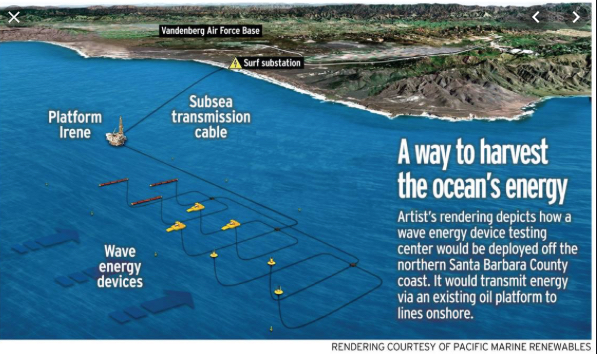 If some of this discussion sounds familiar you might remember that PG&E did a multi-year wave study off the Vandenberg coast but decided to shelve the idea in 2011.
pictured:PG&E plan from 2008 to use the connection from Vandenberg to Platform Irene
The plan called Central Coast Wave Connect also hooked up to Platform Irene. More recently a 2016 National Renewable Energy Laboratory (NREL) study found the Vandenberg coast to be the “number one site in southern California for wave energy.”
It is possible a Vandenberg project could also involve waves or tides, in the early stages of commercial development that could be part of a demonstration project phase before any large-scale facilities are constructed.One company said to be interested also in bidding on the Vandenberg offshore wind project, UK-based Cierco who says they want to build three 15WW turbines offshore. Alternate bids could save the government money after all.
So why would oil companies want to participate at all in this funeral for fossil fuels?
Oil companies here face a huge cost to completely dismantle their oil rig platforms and might welcome the idea they could be converted to artificial reefs that promote diverse sea life at a far lower cost than complete demolition. One estimate is $100 million vs $5 million.A 2016 federal agency, the Bureau of Safety and Environmental Enforcement estimate was that the four offshore oil platforms off Vandenberg would cost $99 million,$74 million,$94 million and $37 million each to completely remove. Removing only the oil drilling equipment from the platform is a fraction of the cost, perhaps 5%.
Oil companies might notice – instead of causing harm to wildlife, they would be recognized for enhancing their habitat. The idea has been promoted as Rigs to Reefs, highlighted by some UC Santa Barbara research earlier this year.
“….these hulking structures, rising hundreds of feet from the ocean floor, provide a unique habitat. The complex shape of the rig’s support creates a 3-dimensional reef for animals to colonize and live near. And the rig’s open construction allows currents to pass through, bringing nutrients ….as far as the marine life is concerned, they already are reefs.”