Golden State’s high-tech thrives while ag exports suffer
October 9,2018
California does not export much corn, pork or soybeans, like Midwest farmers. What we do export – billions worth of farm products, is being impacted by President Trump’s trade war with China and other nations. Among most of the state’s top crops, ag producers are feeling the losses where it hurts, in their wallets.
 The latest trade figures show California’s farmers suffering even as the state’s high-tech sector has yet to feel the pain.
China was the top export destination for Tulare County farm exports last year. Tulare County farmers sent almost 6.3 million cartons of produce to China according to the 2017 Crop Report – a 3 fold increase from 2014. Rising exports have been a bright spot for the county’s farm economy with China-destined fruit shipments increasing from 5.4 million cartons in 2016 and 2.1 million cartons to China in 2014.
So far this year through July, shipments by cartons to China are down about 10% compared to the same time a year ago.Most of that is oranges which pick up with the new citrus crop toward the end of the year as we approach the Chinese New Year.
“We are concurred about our exports to China” says Exeter/Ivanhoe Citrus general manager Terry Orr, since about 20% of the orange crop goes to China.” But we think we can recapture some that that through Hong Kong, where there are no tariffs”, he adds.
Producers hope the trade dispute wont last through December, but there is apparently no progress in talks.“Nothing is imminent on China,” said trump advisor Larry Kudlow recently. “I think there’s discussions going on. No, I wouldn’t say it was imminent.”
But the price crunch is now.
What is not listed on the fruit export shipment list is the number-one crop – milk. But the industry is watching. After running well above year-ago levels through May before the tariff hike was announced, U.S. dairy product export revenue from China fell 27.1% in July and 33.2% in August says the California Milk Producers Council.
The dairy industry remains depressed knowing that the key to higher milk prices depend on stronger dairy exports. The Dairy Export Council said on October 5 that cheese exports were 28,171 tons in August, down 7% from last year. Cheese shipments to Mexico (6,610 tons, -21%) were lower for the second straight month, when additional tariffs were implemented. Results were mixed among other top markets. Strong gains were posted in exports to Central America (+33%). Exports to Australia were the most in nine months, while shipments to South Korea were the lowest in seven months. Sales to China and Canada were both off more than 40% vs. year-ago levels.
Grape growers too say tariffs from China have rattled their markets according to the California Farm Bureau. Exports of California table grapes to China dropped 40 percent once it began imposing extra tariffs this spring. Shippers have been seeking new markets for the grapes. Typically, more than one-third of the state’s production is exported. The California table-grape harvest has reached midseason, with marketers expecting a slightly larger crop than last year’s.
In retaliation to US tariffs on steel imports from China, the Asian nation increased tariffs – a tax on key U.S. imports – including cherries, apples, citrus, grapes and almonds from 10% to 50% since April – and shipments have predictably dropped since.
One shipper told the press they are feeling the impact this summer. “Paramount Export of Oakland, is an 80 year old, employee owned company of 115 people exporting fruit and produce worldwide. Folks here, felt the first impacts in June when tariffs were hiked to 25%. Today, that’s now a distant memory.
“Tariffs on lemons are up to $35 a carton which essentially doubles the price of the shipment,” said sales associate Dave Najarian. “Already our customers say, we can expect a seventy to eighty percent decline in the volumes of produce that we’re shipping to China or to Hong Kong,” said company president Nicholas Kukulan. That could end up being a $2 billion a year hit on agricultural exports to China on our farmers.”
The company says China has also slowed the import inspection process at the ports making it more difficult to get into the country.
Consider this as well. “Loss of Chinese customers to other nations who have the same products, lower labor costs and no new tariffs. “If that means looking to Spain, if it means looking to Egypt, some other sources for the same apples, grapes, citrus; they’re gonna go for it and once it’s gone, it’s gone,” said Mr. Kukulan.
It’s very tough, say Paramount’s sales force, to win Chinese customers back, especially if there are hard feelings on their part, which there are.”
There are more unfavorable ripples as farmers looks to sell their produce elsewhere now – lower prices.
The Bakersfield Californian recently reported that “supplies of California table grapes and almonds are being met with sluggish prices that people in the industry say result at least partly from a trade war that has spawned steep tariffs — in China, 50 percent on the price of almonds, 53 percent on grapes — and opened opportunities for competitors in other countries.
Based on estimates by local growers, table grape prices have fallen as much as 40 percent from a year ago, while almond prices have slipped between 5 percent and 9 percent.”
Impact of trade disputes echoes through farm economy
Even farmers who sell all their crops domestically feel the impacts when trade disputes affect agricultural exports, according to California Farm Bureau President Jamie Johansson. Speaking to the State Board of Food and Agriculture recently, Johansson said when crops can’t be exported as usual, they’re sold in the domestic market, affecting prices there. He said Farm Bureau is encouraged by the U.S.-Mexico-Canada trade agreement finalized this past week.
However despite the deal in the past few days over Canada and Mexico’s trade – tariffs are expected too stay in place unless the U.S. grants an exemption on steel and aluminum tariffs which started this whole thing and were not resolved by the new NAFTA announcements.
Almonds may be the crop where tariffs will bite the most.The Almond Board of California recently released the August position report ( detailing shipments) that showed a sizable decrease in almond exports from a year ago. In 2017, there were 168,566,752 pounds of almonds shipped in August. This year experienced a decrease of nearly nine percent, shipping only 154,227,371 pounds. As of August 31, the report also showed 189,498,340 pounds of crop receipts, a decline of slightly more than 12 percent from 2017.
“I believe that tariffs have a very significant role in what the almond industry is facing today,” said Almond Alliance of California President and CEO Elaine Trevino. “In China, we’re hit with a 50 percent retaliatory tariff and a 25 percent retaliatory tariff in Turkey, and of course everyone continues to watch what’s going to happen in India.”
Trevino noted that excluding Vietnam and Hong Kong, the Chinese market represents $500 million in value and Turkey is valued at roughly $147 million. “When you have those kinds of retaliatory tariffs in those markets it will have an impact,” Trevino stated.
Hay Exports Hit
The value of U.S. hay exports reached about $1.5 billion last year, almost quadrupling over the previous two decades, as China became the main destination for the alfalfa variety. The trade war is expected to push prices down 7.5% and could cut revenue for alfalfa producers by about $377 million, according to a report from the University of California Agricultural Issues Center in Davis.
More tariffs announced
In the escalating trade conflict between the U.S. and China, more California agricultural products now face new retaliatory tariffs in one of their export markets.
On September 18 China implemented a new round of tariffs on $60 billion worth of U.S. goods, including a wide range of foods and agricultural products. The tariffs came in response to new U.S. duties on $200 billion in Chinese imports.
The new Chinese tariff rates are 5 percent and 10 percent, and target farm products such as wine, cotton, cut flowers and other nursery products, frozen fruit and vegetables, honey, olive oil, canned peaches, fruit juices, wood and other forestry products, and various processing-tomato products including ketchup, paste and sauces.
Some products are new to the growing list being hit with retaliatory tariffs, whereas others such as wine are incurring multiple hits with this current round.
Wine exports
U.S. wine previously faced an additional 15 percent tariff in April, when China first imposed tariffs on $3 billion worth of U.S. products in retaliation for new U.S. tariffs on steel and aluminum imports. This week, China implemented new tariffs of 5 percent and 10 percent on U.S. wine, sparkling wine and other wine-based beverages. When compounded with existing duties, the new total tax rate will equal 79 percent, the Wine Institute said.
Cotton wilting
California’s cotton crop is under pressure too.Roger Isom, president and CEO of the California Cotton Ginners and Growers Association, described the increased tariffs on cotton as “devastating” because the state exports 100 percent of its cotton, with the majority going to China.
California cotton exports to China were valued at $88.5 million in 2016, according to the California Department of Food and Agriculture.
The higher tariffs come at a time when Chinese cotton reserves are depleted and demand is high for the state’s higher-end pima cotton, Isom said.
“Prices on the lint side are very good—or were,” he said. “Once these tariffs started coming out and started being announced, the market has dropped and, more importantly, contracts have been canceled or (there are) no new contracts. We’re sitting on pins and needles as to what’s going to happen.”
Though cotton exporters are looking to alternative markets—California also ships to Europe, Southeast Asia and Mexico—Isom said “those other markets aren’t looking for what we have” or aren’t willing to pay the prices the state’s high-end cotton commands.
He said he’s “very concerned” the tariffs will remain in place past December and into next year, noting that historically when cotton prices become too expensive, buyers turn not only to lower-quality cotton but alternative fabrics such as polyester and rayon.
Meanwhile, shelled almonds and fresh sweet cherries have been added to the commodities eligible to receive direct payments under the Market Facilitation Program, part of a three-part, $12 billion aid package meant to help U.S. farmers directly affected by retaliatory tariffs. Previously, payments were available only to producers of soybeans, sorghum, corn, wheat, cotton, dairy and hogs.
Adding it up – are you better off?
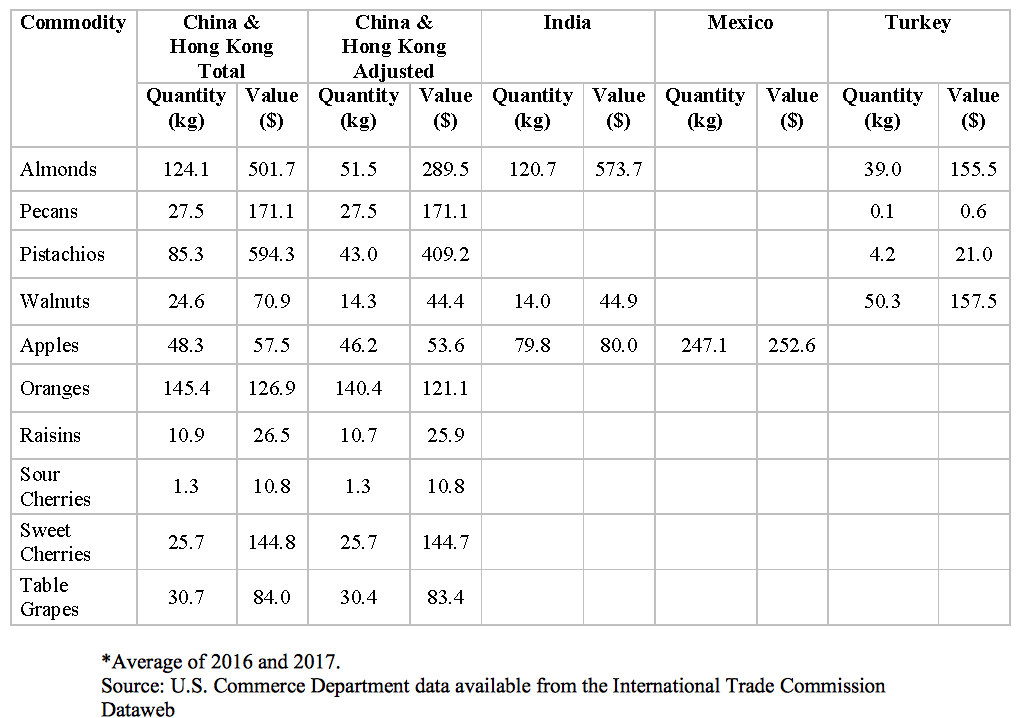
A UC Davis study done in August says California trade losses for the commodities under consideration (not including milk) are about $2.64 billion per year using the export value lost as a measure. Alternatively, using the potential impact on price in remaining markets as the measure of loss, the magnitude is about $3.34 billion (see chart). The bottom line- what you do sell you get paid less for.
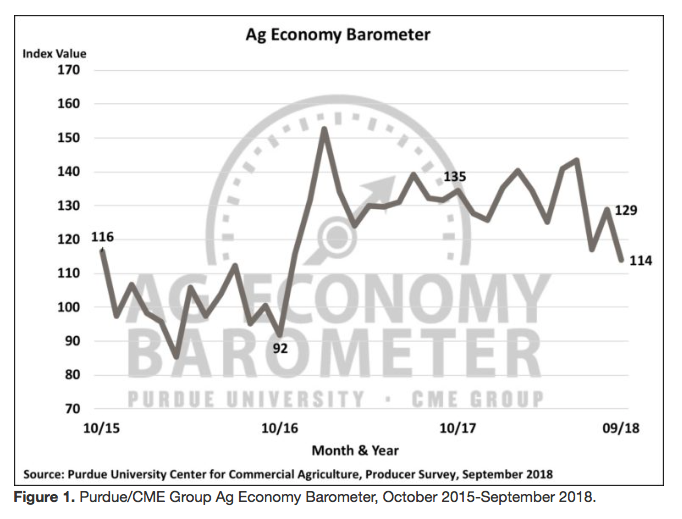
Across the country the trade war appears to be impacting farm sentiment. Purdue University’s Ag Barometer says their index of the ag economy fell in mid-September from a high in November 2017. Producers were asked if their prospects were better off or worse than a year ago – 54% said it was worse.
Trade outlook- high-tech thrives while ag exports suffer
“While it still requires approval, the newly-inked trade deal between the United States and its neighbors, Canada and Mexico, should reduce uncertainty about the trade outlook for California,” said Robert Kleinhenz, Economist and Executive Director of Research at Beacon Economics. “Unfortunately, it appears that positions have hardened in the U.S.-China trade picture, a situation that is contributing to greater uncertainty at this time. The longer these disputes continue, the more likely households will feel the Administration’s tariff policies.”
While exports of manufactured goods were up 4.6% to $9.99 billion from $9.55 billion in August 2017, exports of non-manufactured goods (chiefly agricultural products and raw materials) dropped by 6.3% to $1.54 billion from $1.64 billion. The value of re-exported goods rose by 4.4% to $3.65 billion from $3.50 billion.
The Golden State accounted for 10.9% of the nation’s overall merchandise export trade in August, down from 11.4% last year.
“When President Trump imposed higher tariffs on imported steel and aluminum earlier this year, America’s trading partners retaliated with tariffs that disproportionately targeted agricultural exports, including California fruits, nuts, dairy products, and wines,” said Jock O’Connell, Beacon Economics’ International Trade Advisor.
“So it comes as no surprise that our once vibrant agricultural export trade has suffered, while the state’s high-tech manufacturing sector continues to thrive.”